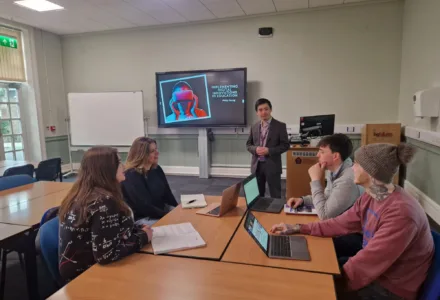
Why study this course
Our Foundation gives you a supported introduction to study, preparing you to transition seamlessly into the full undergraduate course.
Gain a minimum of 120 days’ hands-on classroom experience, building real-world skills from the outset.
Our course is aligned with the latest Department for Education and Teachers’ Standards, ensuring your training is current and respected.
Develop academic, digital, and employability skills that set you apart in the job market and beyond.
Course summary
Please note, this course is now closed for 2026 entry.
Are you passionate about inspiring the next generation? Our BA (Hons) Primary Education with QTS with Foundation Year at Lincoln Bishop University is your gateway to a rewarding teaching career. This dynamic degree is expertly designed to give you the knowledge, skills, and confidence to thrive in primary education, with the added support of a Foundation Year to help you step into university life.
Key facts
|
Award |
BA (Hons) |
|---|---|
|
Duration |
4 years |
|
Mode of study |
Full time |
|
Start date |
September 2027 |
|
Award |
Lincoln Bishop University |
|
Institution code |
B38 |
Apply for this course
When you're ready to apply, the route you take will depend on your personal circumstances and preferred method of study. Click the relevant button below to start your application journey.
About this course
Step into the world of teaching with a course that blends academic excellence, practical training, and personal growth. During your degree, you’ll be immersed in a supportive learning environment, developing your understanding of primary education through innovative modules and extensive school placements. Our programme is mapped to the latest Department for Education and Teachers’ Standards, ensuring you graduate ready to meet the demands of today’s classrooms.
After completing your Foundation Year, you’ll benefit from 120 days of school-based placement, gaining hands-on experience in real-world settings. Alongside, you’ll explore the theories, values, and research that underpin outstanding teaching, guided by passionate tutors and supportive mentors. Whether you’re just starting your journey or need a stepping stone into higher education, our Foundation Year is designed to boost your confidence and academic skills.
Scheduled Teaching Hours
The Foundation Year is the first year of a four-year undergraduate degree and provides a pathway to undergraduate study for students who do not have the typical qualifications required for direct entry to Level 4. As an integrated Foundation Year it does not carry credits, as the purpose of the year is to facilitate students’ progression to Level 4 of their chosen undergraduate degree programme [see Undergraduate].
The delivery of the scheduled hours for the programme includes taught and independent study and is designed to support the needs of learners on Foundation Year programmes as they transition to the requirements of Higher Education study. Material is delivered in both face-to-face and asynchronous formats, totalling 176 hours of taught input, and includes both core academic skills training and additional input from subject specialists. Contact hours in taught sessions are complemented by an extensive support curriculum that operates through the year, typically comprising, but not limited to, additional tutorials, catch-up sessions, study groups, and personal support.
What you will study
Students on this course currently study some or all of the following modules:
In this module, you will gain theoretical understanding and employthe practical application of core academic skills. You will understand the definition and importance of academic integrity and explore the key skills required for effective academic practice. You will develop skills in academic and information literacies, including the ability to locate, evaluate, and reference academic sources. The module will provide guidance and practice on academic writing conventions, critical reading strategies, reflective practice, and effective communication skills. You will consider these skills in the context of your chosen subject area and will engage in a range of learning approaches and opportunities, including tutorials and peer learning
In this module, you will identify and develop personal tools for effective learning as a student in Higher Education. The nature and purpose of Higher Education will be explored, including developing an understanding of independent and autonomous learning. You will
reflect on your own skills as a learner and learn how to establish goals for self-development. A range of functional, organisational, and practical skills to support learning will be introduced, including time management, personal organisation, and professional etiquette. You will also engage in development of your digital skills to enable effective use of digital learning tools in your studies.
In this module, you will define critical thinking and engagement and learn how to apply these in the construction of an academic discussion. You will explore practices to develop critical thinking and learn how to research, construct, and defend an academic argument. You will practise critical engagement with academic sources as part of research and begin developing skills of summary and synthesis to support your own arguments. You will apply critical thinking and engagement skills to an area of inquiry in your chosen subject area.
In this module, you will explore the nature and use of documentary and evidence-based sources within academic practice. The module is interdisciplinary, allowing you to investigate a variety of evidentiary sources such as documentary sources, case studies, archival material, and policy. You will begin to learn to analyse and evaluate such sources critically and to consider them within the broader context of academic research. The use of documentary and evidence-based research across disciplines will be explored, analysed, and evaluated critically.
In this module, you will explore the nature and use of data within academic practices. The module is interdisciplinary, allowing you to investigate a variety of data sources and types, including qualitative and quantitative. You will begin to learn to interpret, analyse, and represent data in a meaningful way. You will learn about different methods of data collection and the use of data across disciplines will be explored, analysed, and evaluated critically.
In this interdisciplinary module, you will explore key ideas, theories, and philosophies that underpin a range of academic disciplines. You will learn how these ideas developed and influenced thinking and evaluate their importance within the context of an academic discipline. The module will explore how such ideas have evolved over time and their influence both on academic practice and broader contexts. You will develop and apply skills of critical analysis to discuss and evaluate the ideas and theories, and have the opportunity to explore them in depth in relation to your chosen subject area
In this interdisciplinary module, you will explore the role and impact of academic practices within the context of local communities. You will explore the social purposes of education, specifically Higher Education, and consider how academic research intersect with community and social practices. The module will explore how different academic disciplines can provide insight and enable interventions into local communities. You will develop and apply skills of critical analysis to explore a topic of local interest in relation to your chosen subject area.
This module aims to introduce students to the skills, knowledge and understanding required to teach pupils in primary and early years.
It will introduce students to the subject knowledge requirements of the primary national curriculum and EYFS framework.
Students will undertake audits to assess and develop their subject knowledge in English and Maths as well as track improvements in their subject knowledge across all curriculum subjects. Students will develop their understanding and knowledge of the school curriculum. Students will understand that a school’s curriculum enables it to set out its vision for the knowledge, skills and values that its pupils will learn, and understand the importance of encompassing a curriculum within a coherent wider vision for successful learning.
Teaching sessions will prepare students for their introductory placement and the Developing Pedagogy, Curriculum and Assessment module in Seminar 2. During the subsequent module students build upon this knowledge to plan and assess these subjects and areas of learning.
In this module you will engage in Intensive Training and Practice (ITaP) sessions concentrating on developing a pivotal teaching skill. ITaPs are a teaching approach and provide opportunity for students to:
• learn about theory in relation to the pivotal skill,
• analyse expert teaching,
• practice the skill and receive feedback,
• receive support to apply their learning,
• reflect on professional development.
The module will be assessed through a formative written assignment. You will make use of your subject knowledge audits and curriculum requirements as part of the assessment.
This module aims to enable students you to develop the skills, knowledge and understanding required to teach pupils in primary and early years. The module builds on the previous PCA Y1 module with a specific focus on planning and assessing each subject. You will develop understanding of the National Curriculum and Early Years Statutory Framework. You will be supported to develop your understanding of the value of specific subject planning, including sequence of lessons and planning for progression in both subject knowledge and skills. You will explore the benefits of cross-curricular planning whilst recognising the importance of sequencing learning across different subjects in order that specific skills and knowledge are mastered. The key elements of what makes a ‘good’ lesson are explored. You will continue to develop their knowledge and understanding of the purpose of formative and summative assessment to inform planning.
This module focuses on aspects of child development and how they link to the Early Years Foundation Stage. You will plan for and evaluate a small-scale project appropriate for young children. Your academic reading and writing is developed in order to be able to produce a literature review.
In this module you will develop your understanding of classroom behaviour management strategies that help create an effective learning environment. You will explore how to build effective relationships, establish and reinforce routines (for example through positive reinforcement) and respond consistently to pupil behaviour (for example through the use of rewards and sanctions). There will also be an introduction to Special Educational Needs and Disabilities (SEND) and how teaching and learning might be adapted to meet the needs of all pupils. In this module you will engage in Intensive Training and Practice (ITaP) sessions (20hrs) concentrating on developing a pivotal teaching skill. ITaPs are a teaching approach and are subsumed within the scheduled hours within the module.
This module focuses on the aspects of professionalism and the role of the teacher in school. You will be introduced to some theories and will develop the ability to think critically to support their academic ideas. This will lead into the introduction of specific teaching pedagogies. In this module you will engage in Intensive Training and Practice (ITaP) sessions (10hrs) concentrating on developing a pivotal teaching skill. ITaPs are a teaching approach and are subsumed within the scheduled hours within the module.
In this module, you will learn how to engage and motivate learners across the curriculum through the use of meaningful materials. You will be introduced to high-quality texts such as poems, picture books, fiction and non-fiction as well as digital-based texts. You will also be introduced to a range of curriculum tools and artefacts that can engage, motivate and stimulate learners within and across different subjects.
You will explore how these may be used to introduce key vocabulary and knowledge as well as generate learning questions to stimulate learning across the topic/subject. You will also consider the wider benefits and concepts in teaching and learning (such as inclusion and diversity, global learning, curiosity). You will develop your knowledge further within intensive training and practice experiences.
In this module, you will find out how to plan sequences and individual lessons to ensure purposeful and coherent learning for children across the primary and early years age range. You will develop your understanding of the interaction between assessment and planning, so that all lessons are adapted to the learning needs and progress of all pupils. You will explore methods of formative assessment and consider the strengths and potential limitations of each and how to design and select approaches suitable for the intended learning, the age/current attainment of the pupil and the requirements of the subject being taught.
Throughout the module relevant literature will be discussed and reflected upon. You will develop your understanding further through intensive training and practice experiences.
In this module you will develop their understanding of the SEND Code of Practice (2015) and topics in relation to Special educational needs and disabilities (SEND). You will explore a range of high frequency SEND such as ASD, Dyslexia and ADHD and strategies to support these children. You will develop an understanding of how schools adapt teaching and learning to meet the needs of all pupils through observation, wider reading and reflection on inclusive teaching.
In this module, you will consider the importance of routines, responses and relationships to create effective learning environments. You will reflect on different approaches to behaviour management and consider how whole-school culture, ethos and school-wide systems of behaviour management can be harnessed in the classroom to create high behavioural expectations. You will have the opportunity to observe, practice and reflect on approaches to behaviour management during your year 2 intensive training and practice experience.
This module further develops aspects of professionalism from Year 1 and the wider role of the teacher in school, including working and developing relationships with a wide range of other professionals and school stakeholders. You will engage in discussions and research around mental health and wellbeing and the impact this can have on outcomes, and develop your understanding in intensive training and practice experiences. The module will build on your academic writing skills at level 5.
This module will introduce you to the processes of conducting research, including ethics and a range of methods commonly used in education. You will be working in groups with other students, supported by a tutor, to design, conduct and analyse the research.
In this module you will learn how to design your own research project. You will create a research question within the field of education and determine how to research this, choosing appropriate methods. The ethical issues related to educational research will be explored, with you identifying those issues most relevant to your topic and considering ways to address these. You will be supported in completing your ethics form and devising your methods.
This module builds on experience at level 5 with research and the previous Level 6 module where you will have designed your own research project. In this module you will collect and analyse data, taking responsibility for ethical practice. The module requires you to be intellectually curious and accept ambiguity. Throughout the module you will be closely supported by a research tutor through individual tutorials and group seminars. You will have the opportunity to carry out research in school where applicable.
In this module you will develop your understanding of the wider lens of inclusion in the classroom. You will explore the impact of building effective relationships and classroom culture to support the needs of children. You will develop your understanding of pupils’ differences, the potential barriers to learning that they may cause, learn strategies to support these children and how to ensure high expectations of all pupils. There will also be links to whole school behaviour culture and how to manage complex behavioural needs. You will have the opportunity to reflect on the development of your inclusive practice over the 3 years via an assessed digital presentation.
In this module, you will build on your learning about the curriculum and subject knowledge from years 1 and 2 as well as reflecting on placement experiences. You will extend your understanding by considering contemporary subject issues, innovative subject developments to the curriculum, and wider curriculum issues pertaining to teaching and learning. You will learn how teachers are research-informed in order to continually improve and develop a curriculum specific to the needs of their pupils and how this is implemented through effective professional development.
This module supports the transition from trainee to ECT (Early Career Teacher) and other roles as you will consider your wider role in the school environment and beyond. The module will explore a range of current issues in education as well as further developing your understanding of how theory and practice are inextricably linked through reflection on your professional journey over the 3 years of the programme.
Entry requirements
To apply to BA (Hons) Primary Education with QTS with Foundation Year you will require a minimum of 48 UCAS points. We welcome a range of qualifications that meet this requirement, such as A/AS Levels, BTEC, T Levels, Access Courses, International Baccalaureate (IB), Cambridge Pre-U, Extended Project etc. To comply with national requirements for the award of QTS, you must also hold GCSE passes in Maths, English, and Science at Grade C/4 (or equivalent) or above. Please see our list of accepted equivalents.
Further information
Click here for key information for all undergraduate students.
Click here for all programme specifications.
The Foundation Year syllabus does not include any specific element of upskilling in English language and you are not entitled to apply for Accredited Prior Learning, AP(C)L into a Foundation Year.
How you will be taught
There is no one-size-fits-all method of teaching at Lincoln Bishop – we shape our methods to suit each subject and each group, combining the best aspects of traditional university teaching with innovative techniques to promote student participation and interactivity.
You will be taught in a variety of ways, from lectures, tutorials and seminars, to practical workshops, coursework and Intensive Training and Practice (ITaPs). Small group seminars and workshops will provide you with an opportunity to review issues raised in lectures, and you will be expected to carry out independent study. There will be up to 20% of online synchronous learning during the course.
Placements are a key part of degree study within many courses at Lincoln Bishop. They provide an enriching learning experience for you to apply the skills and knowledge you will gain from your course and, in doing so, give valuable real-world experience to boost your career.
Assessment
We recognise that individuals come from a wide range of backgrounds and experiences, so we use a variety of assessment strategies in our courses. These include presentations, essays, assessed tutorials, and a research report. All of these individual assessments allow you to reflect on your practice and theory as you evidence your learning.
Careers & Further study
With QTS, you’ll be fully qualified to teach in primary schools across England and Wales. Our graduates are highly sought after for their practical skills, academic knowledge, and reflective approach to teaching. You’ll also have the foundation to pursue further study in areas such as educational leadership, special educational needs, or curriculum development.
What Our Students Say
Discover what life is like at Lincoln Bishop University from our students.
Support
Studying at Lincoln Bishop is a student-centred experience. Staff and students work together in a friendly and supportive atmosphere as part of an intimate campus community. You will know every member of staff personally and feel confident approaching them for help and advice, and staff members will recognise you, not just by sight, but as an individual with unique talents and interests.
We will be there to support you, personally and academically, from induction to graduation.
Fees & Funding
A lot of student finance information is available from numerous sources, but it is sometimes confusing and contradictory. That’s why at Lincoln Bishop we try to give you all the information and support we can to help to throughout the process. Our Student Advice team are experts in helping you sort out the funding arrangements for your studies, offering a range of services to guide you through all aspects of student finance step by step.
Undergraduate course applicants should apply via UCAS using the relevant UCAS code. For 2026 entry, the application fee is £28.95, and you can make a maximum of 5 choices.
For 2027/28 entry the UCAS fee is £34.50.
For all applicants, there are full instructions at UCAS to make it as easy as possible for you to fill in your online application, plus help text where appropriate. Full details of all tuition fees can be found here.
To express your interest in the Primary Education with QTS with Foundation Year course, please complete the form below. Please select Primary Education at the end of the list.
49 Related courses

English Language & Teaching with Foundation Year
Education Studies and TESOL with Foundation Year

PGCE Secondary
PGCE
PGCE Secondary
PGCE Primary (Full Time)

PGCE Primary (Part-Time)

Professional Graduate Diploma in Education (Teaching Post-16 and Further Education)

Professional Graduate Diploma in Education -Teaching Post-16 and Further Education (SEND)

EdD (Doctorate of Education)

Education Studies and English with Foundation Year
Education Studies and English
BA (Hons)
Education Studies and English
International Postgraduate Certificate in Education

Education with TESOL

International Education

Primary Education with QTS
BA (Hons)
Primary Education with QTS
Primary Teaching Studies with QTS
BA (Hons)
Primary Teaching Studies with QTS
Certificate in Education (Teaching Post-16 and Further Education)
Certificate in Education - Teaching Post-16 and Further Education (SEND)
English Language & Teaching
BA (Hons)
English Language & Teaching
Criminology with Foundation Year
BA (Hons)
Criminology with Foundation Year
Education Studies and Sociology
BA (Hons)
Education Studies and Sociology
Education Studies and Sociology with Foundation Year

Education Studies and Theology, Philosophy & Ethics with Foundation Year
Education Studies and Theology, Philosophy & Ethics
FdA Early Childhood Education in Practice (Grantham)
FdA Early Childhood Education in Practice (LETTA)
FdA Education in Practice (Grantham)

FdA Education in Practice (LETTA)

Education Studies
BA (Hons)
Education Studies
Education Studies and History
BA (Hons)
Education Studies and History
Education Studies and Special Educational Needs, Disability & Inclusion (SENDI)

Education Studies and Sport
BA (Hons)
Education Studies and Sport
Education Studies and TESOL
BA (Hons)
Education Studies and TESOL
Psychology and Education Studies
BA (Hons)
Psychology and Education Studies
Education Studies and History with Foundation Year
Education Studies and Special Educational Needs, Disability & Inclusion (SENDI) with Foundation Year
Education Studies and Sport with Foundation Year
Education Studies with Foundation Year
BA (Hons)
Education Studies with Foundation Year
Psychology and Education Studies with Foundation Year

Education
MA
Education
Education (English as an Additional Language)

Early Years Education

Educational Leadership and Management

Special Educational Needs and Disabilities (SEND)

Early Childhood Education in Practice (Grantham)

Early Childhood Education in Practice (LETTA)

Education in Practice (Grantham)
BA (Hons)
Education in Practice (Grantham)
Education in Practice (LETTA)
BA (Hons)
Education in Practice (LETTA)
Early Childhood Education in Practice (Graduate Practitioner) (Grantham)

Early Childhood Education in Practice (Graduate Practitioner) (LETTA)