✨ Apply now through Clearing - call our dedicated hotline on 01522 583698! ✨
Why study this course
The BA (Hons) Early Childhood Studies is a sector approved ‘full and relevant’ programme which offers the opportunity to work towards sector endorsed graduate practitioner competencies
Progressing into Teaching? FREE pre-teaching course and guaranteed interview for PGCE
Have you always wanted to work with young children (ages 0-8) but are unsure on your career pathway? If so then this course is ideal for you.
Course summary
The BA (Hons) Early Childhood Studies is a three-year undergraduate programme which introduces students to aspects of education, health and social care, with a specific focus on children from 0 – 8 years of age.
The course offers graduates a range of employability opportunities with module content supporting students in developing a wide range of transferable skills, as well as providing a curriculum which enables students to develop their academic skills.
Students who graduate from the programme will be awarded a full and relevant degree enhancing employability by enabling them to seek roles in early childhood settings as part of the adult: child ratio. Furthermore, students may also choose to work towards an award which embeds graduate practitioner competencies into their study.
Key facts
|
Award |
BA (Hons) |
|---|---|
|
UCAS code |
X311 |
|
Typical offer |
|
|
Duration |
3 years |
|
Mode of study |
Full time |
|
Start date |
September 2027 |
|
Award |
Lincoln Bishop University |
|
Institution code |
B38 |
Connect with the team
Apply for this course
When you're ready to apply, the route you take will depend on your personal circumstances and preferred method of study. Click the relevant button below to start your application journey.
About this course
The BA (Hons) Early Childhood Studies is a three-year undergraduate programme which introduces students to aspects of education, health and social care, with a specific focus on children from 0 – 8 years of age.
The course offers graduates a range of employability opportunities with module content supporting students in developing a wide range of transferable skills, as well as providing a curriculum which enables students to develop their academic skills.
Students who graduate from the programme will be awarded a full and relevant degree enhancing employability by enabling them to seek roles in early childhood settings as part of the adult: child ratio.
Graduate Practitioner Competencies
Since September 2021, the BA (Hons) Early Childhood Studies programme has offered students the opportunity to work towards the sector endorsed graduate practitioner competencies. This is an optional route designed for students who are specifically seeking a role in the early years sector.
The graduate practitioner route comprises nine competencies which students can meet through assessed placement tasks, observation of practice and academic assignments.
Completed alongside the degree programme, students will complete an evidence-based portfolio in order to be awarded the qualification of BA (Hons) Early Childhood Studies (Graduate Practitioner).
All students who apply for the single honours BA (Hons) Early Childhood Studies course will be offered the opportunity to work towards the graduate practitioner competencies.
Please Note: Students opting for this route must have a GCSE in maths.

Placements
The Placement Services Office endeavours to source placements as efficiently as possible. However, in some cases there may be a delay to the start of your placement while this process is completed, particularly in disciplines facing national shortages and in pinch-point locations. In such cases, the Placement Services Office and your Academic Team will remain in regular contact to support you during this time.
Please be advised that the University cannot guarantee placements in specific locations, and travel may be required.
Scheduled Teaching Hours
Undergraduate programmes consist of 360 HE credits, with each credit equating to 10 hours of learning.
Depending upon the mode of delivery (i.e. face-to-face/in-person, online or a blend of these) and whether your course is full-time or part-time, the delivery of the scheduled hours for the programme will involve taught input, independent study, and where applicable, work-based or placement hours.
What you will study
Please note that we are working to update some of our programme specifications. These represent small updates to optional modules at Level 5 (second year) as part of a normal regular process of updating our courses.
During this module, you will develop knowledge and understanding of personal, social and emotional development of children aged 0-8 years. You will explore the cultural context, and the factors which can impact and shape young children’s personal, social and emotional development. You will be introduced to a range of theoretical approaches in order to appreciate that social and emotional development is complex and can be viewed from differing standpoints, including, sociological, psychological and physiological perspectives. Current research will be considered throughout the module, and its impact on our understanding of the emotional and social development of babies and young children will be evaluated. The holistic nature of development in these areas will be explored as well as the range of personal, family, community and cultural factors which impact on the child. Through this module you will further develop your graduate competencies. These include an understanding of children’s holistic development, focused on personal social and emotional development, and some aspects of neurological development; an understanding of attachment, and personal, social and emotional well-being; and knowledge of the differing theoretical perspectives when planning for children’s personal, social and emotional development, including the role of parents.
In this module, you will study how young children learn, drawing on key theories past and present and considering typical development across the early years. You will explore how practitioners, the learning environment and the Early Years Foundation Stage (EYFS) framework support children’s learning in practice.
You will also cover adult-led, child-led and child-initiated provision, alongside the role of observation and assessment in planning meaningful experiences. Children’s rights and voice are central, with a focus on Article 12 and how practitioners can listen to and advocate for young children. Alongside subject knowledge, you will develop professional skills, academic literacy and employability through interactive teaching, seminars and independent learning.
This module focuses on children’s early communication and language. Exploring the earliest influences on children’s language development, you will learn how children become confident and capable communicators drawing upon a range of developmental, sociological, and psychological theoretical perspectives. You will compare and contrast these perspectives against contemporary research to understand current views about how language develops in the early years. Sessions will also include the role of stories, songs and rhyme in early literacy, and the introduction of phonics. Whilst typical development will be the main focus of the module, children with English as an additional language and the needs of children with speech and language difficulties will also be considered. You will also explore a range of practical strategies to support early language and communication including treasure baskets, story sacks and picture books. Through developing your understanding of children’s early communication and language, you will develop your graduate competencies, including an understanding of children’s holistic development; the ability to listen and communicate with a range of children, including where children may have English as an additional language; and developing your understanding of language development into real world contexts through your placement.
During this module, you will begin to explore aspects of developing professionalism, with a focus on positive relationships, specifically those between practitioners and parents and/or carers. The module will explore the role of parents and/or carers and explore relevant theory and research in relation to the importance of parents and carers. The module will then explore the practitioner’s role in working with parents and carers, underpinned by relevant guidance and legislation. Barriers to effective parent partnerships will be explored, as well as strategies for developing positive relationships. Aspects of inclusivity and bias will also be introduced. Through exploring concepts of positive relationships, focused on parent partnerships, you will develop graduate competency in a range of areas, including; demonstrating knowledge of the importance of parents and/or caregivers; practitioners’ roles in the co-construction of respectful partnerships; and an understanding of the diversity of family life and society, including anti-discriminatory practice and the practitioner’s role in valuing difference.
During this module, you will begin to explore aspects of developing professionalism, with a focus on reflective practice. The module will draw on theories of both adult learning and reflective practice to examine and explore how adults learn, and the role of reflection as a tool for learning and development. You will be asked to evaluate the use of adult learning theories and consider their relevance to current learning, as well as reflecting on your own experiences and considering how these can be used to move forward with your learning. Through exploring concepts of reflection, and exploring your own approaches to learning and development, you will develop subject expertise and increase graduate attributes, most notably academic literacy and employability.
This module explores policy, provision, and practice both historically and currently, providing you with the opportunity to understand what shifts and shapes early years policy and the subsequent impact of policy on practice.
The module presents an historical overview of the development of early childhood provision using the lens of social and political discourse and, through an exploration of the work of key thinkers and philosophers who have influenced current policy and provision. The module includes a study of historical practice and provision for young children and covers the work of early social, educational and health reformers. You will also examine the work of more contemporary thinkers and will be introduced to some alternative education styles.
You will be encouraged to question underlying philosophies and the social and political motivations for shaping policy when creating provision for young children. You will be encouraged to reflect on your own personal philosophy and how this might have been influenced, and how this may subsequently influence your own practice.
During this module, you will have the opportunity to develop your graduate competencies with regards to your understanding of the relevant frameworks, and how these are applied to practice, as well as developing your understanding of policy.
Unlock the secrets to effective learning! This module explores how we learn, offering innovative approaches and tools to help you and your future learners become lifelong, independent thinkers. Perfect for anyone passionate about inspiring curiosity and resilience in education.
Compulsory modules
This module explores the factors which impact upon the health of children within their families, schools and communities. You will explore children’s health and well-being from theoretical and practice-based perspectives, considering the theories and historical contexts which have influenced policy and practice regarding children’s health in the UK, and the relationship between poverty, social marginality and children’s health. You will develop an understanding of legislation and statutory procedures relating to supporting children’s health in early years’ settings, as well as ‘good practice’ in supporting children’s mental, physical, emotional and nutritional health needs. You will consider inclusive and respectful ways in which health and healthy lifestyles can be promoted to children, their families and communities. You will reflect on the implications for practice and the role and responsibility of the Early Childhood Practitioner in advocating for young children’s rights and participation. Concepts of children’s rights and children’s voice will be considered and the module will address some of the challenges that arise around issues of power and control when listening to the voices of young children and encouraging their participation in issues which are relevant to them.
Become a champion for children’s safety and welfare. This essential module covers safeguarding principles, policies, and practices, ensuring you’re prepared to protect and advocate for vulnerable individuals in educational and care settings.
This module will present you with the opportunity to revisit some of the behaviour theories first introduced at level 4 in the module ECS40221, but you will be encouraged to contextualise these in relation to how these might be used to promote positive behaviour of children in early year’s settings. You will consider some of the reasons behind challenging behaviours in the early years and will develop an understanding of associated medical conditions which might impact on behaviour such as autism, attention deficit disorder and oppositional defiance disorder.
This module focuses on the diversity of children’s needs in the context of early childhood practice. You will critically analyse contemporary values, debates and attitudes around special educational needs, disability and inclusion and gain knowledge of current practice, legal and statutory guidance relating to early childhood education and care. You will explore the complex nature of special educational needs and disability and consider ways to plan and support for the the individual child, including through multi-agency and collaborative working. Case studies and examples of practice will be used to illustrate aspects of need. The theories, principles and approaches to social, cultural and educational inclusion will be considered and how these relate to legal and statutory policies and procedures. You will explore ways to develop inclusive practice in early childhood settings and schools and will be encouraged to reflect on your own values and experiences and how these influence your practice.
Optional modules
This module is a placement module for those students who have opted to follow the competency route. The module comprises a total of 30 days of placement split over two semesters. It will present you with the opportunity to develop your professional skills while working in an early year setting. While on placement you will be required to work with setting mentors in undertaking a number of professional duties including taking responsibility for an area of the classroom environment, planning and delivering activities for a group of children and planning an activity to undertake with professional colleagues. Building on your skills as a reflective practitioner, you will reflect on the impact of your role in the setting through the development of a reflective journal. You will work independently, leading your own lines of inquiry, supported by an online/face-to-face blended approach to peer and tutor-led group tutorials, as well as support through the placement mentor and personal tutor observations and meetings.
In this module you will explore the concept of ‘childhood’ from philosophical, sociological and psychological perspectives. Common assumptions about children and childhood will be identified and you will consider how these perceptions are socially constructed according to historical time, place and culture, drawing upon the work of a range of philosophers and educational pioneers. Western perspectives of the child and childhood will be critiqued and contrasted with non-Western views and practices.
The module will explore some of the contemporary debates around children and childhood today and consider implications for practice in the early years.
This module equips you with an understanding of Corporate Social Responsibility and sustainability in regional, global and organisational contexts.
You will be empowered to take positive action as an informed global citizen in line with The 2030 Agenda for Sustainable Development, adopted by all United Nations Member States in 2015. The Agenda provides a shared blueprint for peace and prosperity for people and the planet, now and into the future. At its heart are the 17 Sustainable Development Goals, which are an urgent call for action by all countries, developed and developing, in a global partnership. They recognise that ending poverty and other deprivations must go hand in hand with strategies that improve health and education, reduce inequality, and support economic growth, while also tackling climate change and working to preserve our oceans and forests. These SDGs will therefore underpin the teaching and learning ethos of this module.
Through undertaking the module, you will begin to develop the knowledge and skills required to shape practices for managing and leading Corporate Social Responsibility and sustainability in an organisational setting.
The approaches taken to manage and lead CSR and sustainability differ according to the nature and purpose of individual organisations. For this reason, the critical exploration of case studies will help you develop a fuller understanding of CSR and sustainability in a variety of organisational contexts.
*NB Students may be able to elect modules of study from other subject areas, subject to availability, timetabling, and capacity. Where this is possible information will be made available by the Faculty.
This module introduces you to the ideas, practices and challenges involved in understanding communities and contributing to social purpose. It explores how communities form, how they experience and respond to social issues, and how you, alongside individuals, groups and organisations, can support positive social change.
You will examine a range of perspectives on community, identity, belonging and participation, and consider how social purpose is expressed through collaborative activity, civic engagement and initiatives aimed at improving collective wellbeing.
Through a combination of theoretical exploration and applied learning, you will develop the ability to analyse the characteristics, needs and dynamics of different types of communities. The module encourages your critical thinking, ethical awareness and practical skills for engaging with community issues and contributing to meaningful social purpose.
The module uses a blend of learning approaches designed to support your critical enquiry, collaborative learning and the application of ideas to real-world contexts.
Assessments are designed to evaluate your ability to apply relevant theoretical frameworks, draw on appropriate evidence and formulate practical strategies for supporting social purpose in ways that align with your particular field of study.
*NB Students may be able to elect modules of study from other subject areas, subject to availability, timetabling, and capacity. Where this is possible information will be made available by the Faculty.
Compulsory modules
In this module you will reflect on the impact of change on the developing child, with a focus on the range of transitions which children experience from birth to 8 years.
The module will draw from research which argues that if a child is taught to cope with the expected changes that are anticipated through childhood, then they will develop better coping mechanisms when faced with unexpected changes. You will be encouraged to reflect on the changes experienced by children in a rapidly changing society and will examine some of the strategies which might be used to support children through these expected and unexpected changes. A key focus of this module will be that of the promotion of resilience, resourcefulness and reciprocity, and the role of the adult in fostering these in children in order to prepare them for a future of change and supporting more positive outcomes into adulthood.
This module will introduce you to the research process in preparation for the sector based research project in semester 2. You will learn about research design and ethical implications of undertaking research with children and their families in an early years setting.
This module will enable you to gain an understanding of key elements of the research process applicable to researching issues in early years. Elements of the research process will be introduced, including literature review, data collection and generation, analysis and data interpretation and presentation of findings. Ways in which rigour can be established will be discussed (e.g. triangulation, generalisation, reliability, validity etc).
The module will introduce you to some different research methods commonly used in early years settings, e.g. observation, interview, questionnaire and consider the relevance of documentary and visual texts. In addition to the traditional learning and teaching strategies, this module will use peer to peer support through collaborative working in which learning ‘about’ the processes of research is explored through online and practical activities (e.g. devising a questionnaire using online software).
You will undertake independent work in developing knowledge and understanding and in working towards a portfolio set of assessed tasks. This module will also be underpinned by a placement in which you will negotiate an area of research with your placement setting.
This module will introduce you to some of the ethical implications of undertaking research with children and their families in an early years setting, including the key principles of anonymity, confidentiality and informed consent, when researching babies and young children. You will be encouraged to reflect on the conceptualisations of the child as subjects, as well as considering the role of the child as co-researcher.
In addition to the traditional learning and teaching strategies, this module will use peer to peer support through collaborative working in which learning ‘about’ the application of research ethics is explored through online and practical activities. You will undertake independent work in developing knowledge and understanding and in working towards the development of your own ethics form. This module will also be underpinned by a placement in which you will negotiate an area of research with your placement setting.
In this module you will have the opportunity to independently research an aspect of early years provision in a placement setting. You will be expected to negotiate an area of focus with your placement mentors and will design, plan and implement an area of study with a view to facilitating change or supporting provision in your setting.
Ethical issues will be addressed, including the key principles of anonymity, confidentiality and informed consent. Specific guidance will be given for the analysis of data and the production of a research dissertation.
You will be expected to think strategically and analytically and to work independently and autonomously as appropriate within agreed guidelines. There will be an emphasis on enabling you to demonstrate the limitations and uncertainty of knowledge and the influence of perspective and theoretical/methodological approach on findings and conclusions.
This module will enable you to contribute to the work of your placement settings, through the negotiation of your research focus, setting change management and improvement priorities and engage in creating and leaving a ‘legacy’ from your research as you make the transition from ‘knowledge consumer’ to ‘knowledge producer’.
In this module you will be introduced to theories and models of leadership and management as they apply to an educational setting. You will be encouraged to reflect on the range of leadership roles within an early year setting and will consider how these have changed and developed from an historical perspective relating to policy and legislation in the early childhood sector.
You will reflect on the complexity of managing provision in an ever-changing landscape and will examine some of the challenges and opportunities of working with a range of stakeholders through effective teamwork and application of different leadership styles. Leadership will be set in the contemporary contexts of leadership for learning, multi-professional leadership through working with families and communities and self-evaluation leading to improvement in provision and practice in early childhood settings. These will be explored through a reflection on the skills and attributes needed by leadership and managers in early years contexts.
Optional modules
In this module you will have the opportunity to build on your understanding of the constructs of ‘childhood’ through an examination of past and present contexts, and the challenges and possibilities of global and future childhood.
You will be encouraged to reflect on a number of thought-provoking debates around global issues surrounding childhood, including child labour and child soldiers, child marriage, the global impact of social media on childhood and the global inequalities in education and health. You will be introduced to some of the policy and legislation around protecting the rights of the child and will reflect on the nature of children as objects of National and Global concern.
This module will develop knowledge and understanding of methods and practice in teaching and learning in the 0-8 age range. This will build on some of the models of child development first introduced at Level 4 with an emphasis on the role of the practitioner in supporting and extending learning.
You will be encouraged to critically reflect on the pedagogical underpinnings of the current Early Years curriculum and will be introduced to some of the more recent developments in developing children’s learning through the processes of deep learning, deep thinking, emotional satisfaction and engagement with others. The notion of creativity will be explored through an exploration of some of the more progressive views of early education and through an examination of alternative curricular such as Forest Schools, In the Moment Planning and The Curiosity Approach.
In addition to the traditional learning and teaching strategies of interactive lectures, seminars and discussions, this module will encourage you to reflect on ideas in relation to your experience of everyday practice. Through practical workshops you will explore aspects of an alternative curriculum in order to form your own ideas about provision in the early years.
Entry requirements
| Typical offer | |
|---|---|
| A-levels | CCC-BCC |
| UCAS points | 96-104 |
| BTEC | MMM |
| T-levels | P |
You will normally need 96-104 UCAS tariff points (from a maximum of four Advanced Level qualifications). We welcome a range of qualifications such as: A/AS Levels, BTEC, Access Courses, International Baccalaureate (IB), Cambridge Pre-U, Extended Project etc.
However this list is not exhaustive – please click here for details of all qualifications in the UCAS tariff.
You will be required to pay for an Enhanced Disclosure and Barring Service (DBS) check and placement related travel costs (according to the Student Transport, Accommodation and Subsistence Policy).
You will also need GCSEs in English Language and Mathematics at grade 4 (previously C) or above (or equivalent).
Further information
Click here for key information for all undergraduate students.
Click here for all programme specifications.
In accordance with University conditions, students are entitled to apply for Recognition of Prior Learning, RP(C)L, based on relevant credit at another HE institution or credit Awarded for Experiential Learning, (RP(E)L).
How you will be taught
There is no one-size-fits-all method of teaching at Lincoln Bishop – we shape our methods to suit each subject and each group, combining the best aspects of traditional university teaching with innovative techniques to promote student participation and interactivity.
You will be taught in a variety of ways, from lectures, tutorials and seminars, to practical workshops, coursework and work-based placements. Small group seminars and workshops will provide you with an opportunity to review issues raised in lectures, and you will be expected to carry out independent study.
Placements are a key part of degree study within many courses at Lincoln Bishop. They provide an enriching learning experience for you to apply the skills and knowledge you will gain from your course and, in doing so, give valuable real-world experience to boost your career.
Academic staff
Assessment
We recognise that individuals come from a wide range of backgrounds and experiences, so we use a variety of assessment strategies in our courses. Assessments in Early Childhood Studies take place at the end of each module in order for you to demonstrate your understanding of the objectives covered. A wide range of assessment methods is used to support your learning, including the production of portfolios, presentations and displays. You’ll also be assessed through written essays, discussions, debates and multimedia projects. Assessments are not only designed to assess your knowledge and understanding but also help you to develop transferable skills which will support you as you enter the early year's workforce.
Careers & Further study
Early Childhood is a growing sector and the practical nature of this course will enable you to develop the skills with which to enter the children’s workforce in a range of different roles, such as classroom assistant, playworker, key person or room leader. Furthermore, the option of the Graduate Practitioner route as a sector endorsed qualification gives employers the confidence that knowledge and skills gained on this course will enable graduates to confidently take up these positions in early years settings. Our graduates have entered the workforce as early years practitioners and room leaders in early years settings, before going on to management roles or opening their own early years settings.
Some of our students seek a route into teaching through a PGCE qualifications whilst others enter other teacher training routes for example through School-Centred Initial Teacher Education (SCITT). The BA (Hons) Early Childhood Studies course provides a secure foundation for teaching in the Primary age range, offering modules in child development, pedagogy and practice and behaviour, all of which underpin Primary Education.
Alongside teacher training our graduates have also gone on to further study in areas of specialism in health and social care, including social work, speech and language or midwifery,. The diverse nature of this course also enables graduates to go on to further study such as postgraduate study on a master’s degree, seeking wider opportunities in many different fields, including health and social care, children’s social work, play therapy and speech and language therapy. Lincoln Bishop also offers a Master’s Route in Early Years Education for those seeking to further their specialism in the discipline.
What Our Students Say
Discover what life is like at Lincoln Bishop University from our students.
Support
Studying at Lincoln Bishop is a student-centred experience. Staff and students work together in a friendly and supportive atmosphere as part of an intimate campus community. You will know every member of staff personally and feel confident approaching them for help and advice, and staff members will recognise you, not just by sight, but as an individual with unique talents and interests.
We will be there to support you, personally and academically, from induction to graduation.
Fees & Funding
A lot of student finance information is available from numerous sources, but it is sometimes confusing and contradictory. That’s why at Lincoln Bishop we try to give you all the information and support we can to help to throughout the process. Our Student Advice team are experts in helping you sort out the funding arrangements for your studies, offering a range of services to guide you through all aspects of student finance step by step.
Undergraduate course applicants should apply via UCAS using the relevant UCAS code. For 2026 entry, the application fee is £28.95, and you can make a maximum of 5 choices.
For 2027/28 entry the UCAS fee is £34.50.
Undergraduate and PGCE fees for 2027 entry will be confirmed following a UK Government announcement by the Department for Education (DfE), expected in late 2026.
For all applicants, there are full instructions at UCAS to make it as easy as possible for you to fill in your online application, plus help text where appropriate. Full details of all tuition fees can be found here.
Early Childhood Studies at Lincoln Bishop Podcast
Welcome to our podcast by the Early Childhood Studies team at Lincoln Bishop. This podcast aims to cover all things early years, including some of the things we 'get up' to here at the university and conversations with those working in the sector to help us understand what early childhood studies means to them.
A useful podcast for students and practitioners alike.
Latest Episode
Sam Hoyes interviews Rachel, a Bishop Grosseteste graduate from our Early Childhood Studies degree, who shares her journey from the UK to Australia! Rachel discusses her experiences in different educational systems, the importance of play-based learning, and the differences in teacher pay and support in Australia compared to the UK based on her own experiences.
Ethical considerations of doctoral methodologies Podcast
Dr Nyree Nicholson is a Programme Leader on the Professional Studies work-based programmes in Education, Early Childhood and Childhood and Youth pathways. The title of her doctoral research was “Supporting children with identified speech, language and communication needs at two-years-old: voices of early years practitioners”. Nyree utilised a narrative hermeneutic methodology with conversational interviews to explore the lived experiences of fifteen early years practitioners.
Samantha Hoyes is a senior lecturer in Early Childhood Studies and is currently part way through her PhD. Her focus is on working motherhood in the 21st Century and how working mothers make sense of their identities. Applying a post-structuralist feminist approach, Sam has utilised photo elicitation interviews to explore working mothers lived experiences. Sam's sample will consist of 10-15 working mothers living in Lincolnshire with a child/ children aged 0-5 years at the time of data collection. She is currently around halfway through her initial data collection.
In this podcast, Nyree and Sam discuss the methodological approaches taken in the research process and share the ethical considerations they encountered throughout the research process.
For any more question or queries please contact Samantha.hoyes@lincolnbishop.ac.uk and nyree-anne.nicholson@lincolnbishop.ac.uk
Find your course
Your future is waiting. Explore our courses and apply now for 2027 entry at the UK’s No.1 university for student satisfaction. 🎓
Showing 1 courses

Health & Wellbeing in Early Childhood
BA (Hons)
Health & Wellbeing in Early Childhood16 Related courses

Children’s Literature and Literacies
Health & Wellbeing in Early Childhood
BA (Hons)
Health & Wellbeing in Early Childhood
FdA Early Childhood Education
Early Childhood Education (Top-Up)
BA (Hons)
Early Childhood Education (Top-Up)
Special Educational Needs, Disability & Inclusion (SENDI) and Early Childhood Studies
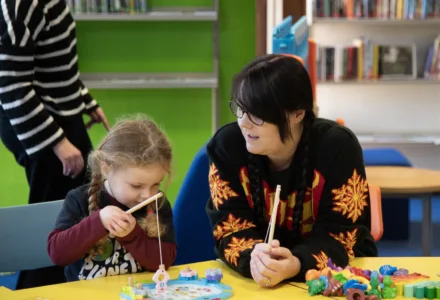
FdA Early Childhood Education in Practice (Grantham)
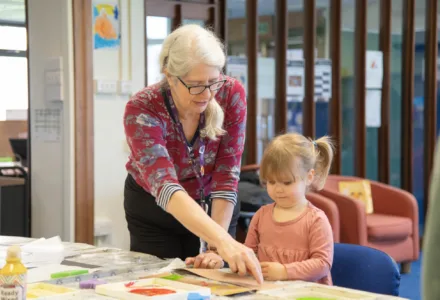
FdA Early Childhood Education in Practice (LETTA)

Psychology and Early Childhood Studies
BA (Hons)
Psychology and Early Childhood Studies
Early Childhood Studies with Foundation Year
Health & Wellbeing in Early Childhood with Foundation Year
Psychology and Early Childhood Studies with Foundation Year
Special Educational Needs, Disability & Inclusion (SENDI) and Early Childhood Studies with Foundation Year

Early Childhood Education in Practice (Grantham)
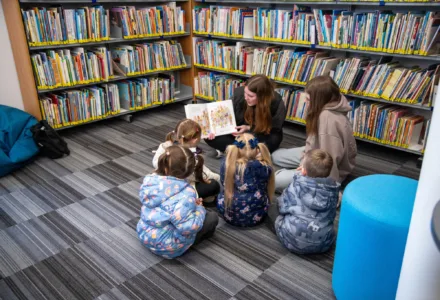
Early Childhood Education in Practice (LETTA)

Early Childhood Education in Practice (Graduate Practitioner) (Grantham)

Early Childhood Education in Practice (Graduate Practitioner) (LETTA)