Why study this course
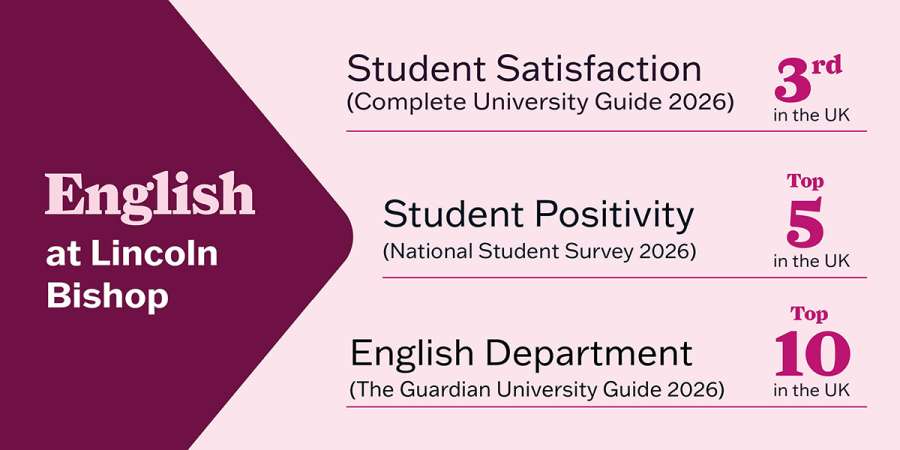
Top 10 English Department in the UK (The Guardian University Guide 2026)
UK’s 1st English Department for Academic Support (National Student Survey 2025)
UK’s 1st English Department for Learning Opportunities Support (National Student Survey 2025)
UK’s 1st English Department for Teaching (National Student Survey 2025)
Course summary
Studying English Literature at Lincoln Bishop offers an exciting and wide-ranging exploration of the power of human creativity and the rich heritage of literary expression. On this course, you will encounter great works of literature by authors from Ovid to Ali Smith, and from Shakespeare to Bernardine Evaristo, Salman Rushdie, and Chimamanda Ngozi Adichie. Your studies will be enriched by opportunities to explore creative and environmental writing, detective fiction, world literature, drama, children’s literature, film, and literature from the Victorian, Romantic, and contemporary periods
Key facts
|
Award |
BA (Hons) |
|---|---|
|
UCAS code |
Q300 |
|
Typical offer |
|
|
Duration |
3 years |
|
Start date |
September 2027 |
|
Award |
Lincoln Bishop University |
|
Institution code |
B38 |
Connect with the English team
Apply for this course
When you're ready to apply, the route you take will depend on your personal circumstances and preferred method of study. Click the relevant button below to start your application journey.
English Literature at Lincoln Bishop is...
1st

in the UK for student satisfaction (English)
(NSS 2022)
1st

in the UK for graduate prospects (English)
(Sunday Times Good University Guide 2021)
2nd

in the UK for Teaching (English)
(NSS 2023*)
About this course
Studying English Literature at Lincoln Bishop provides an exciting and wide-ranging engagement with the power of human creativity and the rich heritage of literary expression. On this course you will study great works of literature from Ovid to Ali Smith and from Shakespeare to Bernardine Evaristo, Salman Rushdie, and Chimamanda Ngozi Adichie, enriching your learning with explorations into creative and environmental writing, detective fiction, world literature, drama, children’s literature, film, Victorian, Romantic, and contemporary literature.
As an English Literature student at Lincoln Bishop, your engagement with literature won’t stop at the seminar door. The English team are all research-active lecturers who are passionate about the study of literature and its positive impact on the individual and wider society. We actively support a range of organised events and visits to enable wider participation in literary culture, including visiting speakers, a research seminar series, subsidised film and theatre trips, workshops and celebrations, poetry readings, and literary awards. Among these is Lincoln Bishop’s Tennyson Poetry Award which invites students to craft an original poem inspired by the works of Lincolnshire born Victorian Poet Laureate Alfred Lord Tennyson. Situated in the heart of historic Lincoln, our course offers further opportunities to explore the city’s rich literary heritage, from Chaucer’s The Canterbury Tales - which reference the medieval legend of Little Hugh of Lincoln - to the contemporary work of Benjamin Zephaniah, who spent his later years in Lincolnshire and is annually celebrated with our Benjamin Zephaniah Day.
You will acquire key academic and transferable skills such as critical thinking and evaluation, analysis, research and high-level communication skills through diverse methods of assessment, which blend established critical and communication skills with up-to-date digital literacies and platforms. You will develop expressive and creative skills fit for the 21st century; combining written essays and oral presentations with e-portfolios, multimodal video, posters, hypertext, digital publication, and independent research projects. You will benefit from an innovative and flexible approach to teaching and learning that promotes student participation and engagement. With the close academic support you will receive here at Lincoln Bishop, you will have the opportunities and guidance to fulfil your full potential.
Discover first-hand why we have such a strong reputation for student satisfaction and teaching excellence, and prepare for a plethora of future professional opportunities.
Scheduled Teaching Hours
Undergraduate programmes consist of 360 HE credits, with each credit equating to 10 hours of learning.
Depending upon the mode of delivery (i.e. face-to-face/in-person, online or a blend of these) and whether your course is full-time or part-time, the delivery of the scheduled hours for the programme will involve taught input, independent study, and where applicable, work-based or placement hours.
What you will study
Please note that we are working to update some of our programme specifications. These represent small updates to optional modules at Level 5 (second year) as part of a normal regular process of updating our courses.
This module introduces you to the literary-critical skills and approaches that are fundamental to the study of English. It will equip you with specialist analytical terminology and techniques while reinforcing and developing your existing skills of analysis. You will consider the construction of a range of texts drawn from different genres and literary-historical periods. Particular attention will be paid in taught sessions to the subject-specific research, planning and writing skills that you will need throughout your degree. Teaching will also support the development of digital skills in advance of the final assessment. You will develop your knowledge and skills through in-class discussion, directed research tasks and independent study. Some sessions will be explicitly student-led: you will be encouraged to read beyond the texts specified and asked to contribute questions for class discussion. University-level research skills will be embedded in taught sessions, with support from the Hub.
This module is an introduction to Gothic effects, such as suspense, mood, eeriness, the weird, fantasy and horror. It covers texts from the eighteenth century to the present to build students’ knowledge of the rise of the Gothic as well as its different manifestations in different genres and creative outputs, such as the novel, poetry and film. It also contextualises the Gothic by identifying its conventions, themes and motifs, such as the graveyard, the supernatural and monsters. Because of this module’s focus on Gothic as evoking effects, this module lends itself to psychological and sociological approaches and as well as links to key concepts and ideas explored on subsequent genre and period modules. Teaching pays special attention to the close reading of primary texts and the development of written skills in advance of the final assessment.
This module offers an introduction to some of the literary works, frameworks, and cultural developments in modern American literature. The primary texts will be drawn from a variety of genres and forms of writing, and will cover a period from the emergence of modern literature in the early twentieth-century through to the diversification of American cultural voices in the post-war period. Teaching will pay particular attention to the enhancement of close reading skills and the development of oral argument and presentation skills in advance of the final assessment. The module also establishes the conceptual foundations for subsequent ‘period’ modules though its dual exploration of aesthetic innovation and societal change, as you evaluate a body of works that represent, and critically respond to, the ideals, myths and values of the ‘American century’.
Have you ever stopped to wonder about the origins of your favourite texts? When did human beings first begin writing down, recording, and retelling stories from their lives and imaginations? This one-of-a-kind module introduces you to the most important foundational myths, legends, fables and stories to have ever informed Western literature and media. It traces how literary texts have drawn on and transformed potent myths, and the impact which changes in society have had upon English literature and Anglophone societies. Primary texts range from Classical works to fairy tales alongside examples of their contemporary adaptations. You will be offered a broad contextual view of these stories and their transformations, and provided with avenues through which to pursue individual research and develop your critical skills.
This module will equip you with the necessary skills to analyse and evaluate poetry. It empowers you to read, analyse, and discuss poems and lyrics by giving you the tools to express your responses to poetry by understanding technical features of poetic form and language. It will give you an idea of the breath and range of poetry in English by developing intertextual connections and recognising its relation to changing contexts. It engages in current debates about the nature and function of poetry, developing three main emphases: skills development, literary knowledge, and theoretical awareness. The module provides an introductory survey of poetry written in English that crosses centuries, poetic genres and forms, metre and rhythm. Its range embraces performance and political poetry, and musical lyrics, as well as written poetry, testing your knowledge through a practical form of assessment that connects visual, digital, and presentation skills.
This module studies Shakespeare’s timeless work and investigates the ways his texts are repeatedly rewritten and performed today. Over 400 years from his death the popularity of his work is not weakened; on the contrary his plays are read, studied, and performed all over the world both in English and in translation. His work is as relevant as ever and it is to be found in the richness of language expressions which still permeate the English language, and in intertextual connections found in multiple, diverse cultural, literary and artistic contexts all over the world. This module provides an introduction to Shakespeare’s range of work and its reception in his time, and a foundation in the use of plays as texts. You will engage in current debates about the nature and function of Shakespeare’s work by reading the work of the Elizabethan bard in relation to changing contexts through a range of production instances. This module emphases skills development, literary knowledge, and internationalisation. It assumes no prior knowledge or engagement with Shakespeare’s work. It provides an introductory survey of his oeuvre and a range of specific case studies by focusing on his plays, ranging from tragedy to comedy. You will reflect on the ways in which his humour, themes, and dramatic twists bridge the difference between age groups and cultures.
This module offers a broad examination of the longstanding and multifaceted relationship between literature and film. It begins with an introduction to the critical vocabulary of film analysis as a means of establishing the semiological differences between film art and traditional literary forms. It then proceeds, through a series of textual and cultural case-studies, to explore key elements of the complex interplay between these two art forms. It examines formal strategies and ideological implications of literary adaptation; the potential synergies and divergences of different literary forms and genres; the cultural translation of adapted texts over time; the parallel development of form in both mediums; and the cinematic framing of specific authors, characters or genres. Overall, the module seeks to foster a greater critical understanding and appreciation of ways both art forms express and embody cultural values and meaning.
Through this module you will embark on a journey to discover world literatures by exploring a range of texts written both by authors whose national languages include English and those whose work has been translated into English. The module studies how literary texts are transformed by cultural transmission, the significance of major technological advances in publishing, as well as the reasons for publishing in English and the variety and diversity of the literature produced in the world. By examining a range of texts by different authors, the module reflects on readership and publishing. It engages with current debates on the nature and function of literature and it helps you to develop critical and analytical skills in recognizing the multifarious nature of world literatures in English by exploring a variety of cultural and literary contexts. This module emphasises literary knowledge and ethical and theoretical awareness. Its range embraces novelists, poets and dramatists from around the world and encourages you to appreciate today’s intertwined global cultures by looking at, for example, the Booker Prize List. You will acquire lifelong skills in interpreting and evaluating texts and learn how to develop and communicate an informed personal response to literature attentive to different cultural contexts and traditions.
This module is organised around key frameworks for the understanding of human and cultural identity; likely to include gender, sexuality, nationality, ethnicity, subculture and social class. The exploration of such frameworks is supported by theoretical materials designed to introduce students to key literary and cultural concepts (such as ideology, patriarchy, heteronormativity, performativity, otherness, diaspora, and hybridity). Literary texts will be drawn from a variety of genres, periods, and cultures, and students will be required to identify, and reflect upon, the correlations between identity and its literary and/or aesthetic expression. Through both seminar discussion and the assignment tasks, students will be encouraged to adopt a pluralistic and comparative approach to the topic, crossing textual and discipline boundaries in their exploration of the interlaced operations of cultural classification and individual self-definition.
This module is organised around key frameworks for the understanding of human and cultural identity; likely to include gender, sexuality, nationality, ethnicity, subculture and social class. The exploration of such frameworks is supported by theoretical materials designed to introduce students to key literary and cultural concepts (such as ideology, patriarchy, heteronormativity, performativity, otherness, diaspora, and hybridity). Literary texts will be drawn from a variety of genres, periods, and cultures, and students will be required to identify, and reflect upon, the correlations between identity and its literary and/or aesthetic expression. Through both seminar discussion and the assignment tasks, students will be encouraged to adopt a pluralistic and comparative approach to the topic, crossing textual and discipline boundaries in their exploration of the interlaced operations of cultural classification and individual self-definition.
This module offers the opportunity for you to study popular literature as a specific field of literary and cultural production. The course will examine key concepts and theoretical issues relating to the popular, including its definition and relationship to genre writing, and the significance of production and distribution practices.
The module programme will address a sample of illustrative texts drawn from popular literary genres such as action-adventure, travel and life writing, romance, crime, sensation and historical fiction, fantasy, horror, and fan fiction. In addition to analysing the distinctive features of selected popular genres, you will examine the social and cultural contexts informing illustrative texts and evaluate their connections to, and articulations of, relevant cultural issues and debates.
This module examines literature written for children and young adults. It engages you with its history and recent successes and transformations and explores its diverse range of genres, such as fairy tales, fables, picture books, poetry, fantasy, and non-fiction. It provides knowledge and understanding of cultural and social contexts, origins of literary form as well as constructions and representations of childhood and youth.
Teaching will pay particular attention to themes, such as suitability and creativity, gender and sexuality, childhood and adolescence, as well as a range of different theoretical approaches that deepens the study of literature written for children and young adults and about childhood and youth.
In recent years, women’s writing has emerged as a major influence on twentieth- and twenty-first-century literature. This module examines the impact of women in literature through a variety of literary forms and transnational parallels and contrasts. It highlights identity politics and the ways in which women have fought to change discriminations based on race, gender, class, age, and sexuality. By bringing together several themes other modules have introduced, this module strengthens your confidence in undertaking independent research. It equips you with increased research skills and resourcefulness in choosing their areas of specialist literary knowledge by exploring women’s writing by weaving a thread of critical enquiry determined by the significance of women’s contributions to literature. In doing so, it follows a chronologic trajectory, which acknowledges the origins of feminism, and an international perspective that encompasses a variety of diverse authors. It tests your knowledge through coursework that facilitates students’ choice and independent research skills.
This module offers a selective survey of multicultural British literature and other cultural products (music, film, visual art) considered in the context of empire and its demise, the migration of people to Britain from the colonised and formerly colonised world, the racist nationalism of the decades following WWII, and the more contemporary phenomena of asylum-seeking and Brexit. We will consider in detail the stylistic and formal properties of a diverse range of texts, from realist novels to performance poetry and visual media.
The module will follow a broadly chronological trajectory, giving students an understanding of the literature in its historical and cultural contexts, tracing shifts in the social and political, as well as literary, landscape of Britain. It will also introduce you to a range of contemporary cultural, postcolonial and feminist theories that will aid textual analysis, as well as connecting to wider artistic and political debates.
This module equips you with an understanding of Corporate Social Responsibility and sustainability in regional, global and organisational contexts.
You will be empowered to take positive action as an informed global citizen in line with The 2030 Agenda for Sustainable Development, adopted by all United Nations Member States in 2015. The Agenda provides a shared blueprint for peace and prosperity for people and the planet, now and into the future. At its heart are the 17 Sustainable Development Goals, which are an urgent call for action by all countries, developed and developing, in a global partnership. They recognise that ending poverty and other deprivations must go hand in hand with strategies that improve health and education, reduce inequality, and support economic growth, while also tackling climate change and working to preserve our oceans and forests. These SDGs will therefore underpin the teaching and learning ethos of this module.
Through undertaking the module, you will begin to develop the knowledge and skills required to shape practices for managing and leading Corporate Social Responsibility and sustainability in an organisational setting.
The approaches taken to manage and lead CSR and sustainability differ according to the nature and purpose of individual organisations. For this reason, the critical exploration of case studies will help you develop a fuller understanding of CSR and sustainability in a variety of organisational contexts.
*NB Students may be able to elect modules of study from other subject areas, subject to availability, timetabling, and capacity. Where this is possible information will be made available by the Faculty.
This module introduces you to the ideas, practices and challenges involved in understanding communities and contributing to social purpose. It explores how communities form, how they experience and respond to social issues, and how you, alongside individuals, groups and organisations, can support positive social change.
You will examine a range of perspectives on community, identity, belonging and participation, and consider how social purpose is expressed through collaborative activity, civic engagement and initiatives aimed at improving collective wellbeing.
Through a combination of theoretical exploration and applied learning, you will develop the ability to analyse the characteristics, needs and dynamics of different types of communities. The module encourages your critical thinking, ethical awareness and practical skills for engaging with community issues and contributing to meaningful social purpose.
The module uses a blend of learning approaches designed to support your critical enquiry, collaborative learning and the application of ideas to real-world contexts.
Assessments are designed to evaluate your ability to apply relevant theoretical frameworks, draw on appropriate evidence and formulate practical strategies for supporting social purpose in ways that align with your particular field of study.
*NB Students may be able to elect modules of study from other subject areas, subject to availability, timetabling, and capacity. Where this is possible information will be made available by the Faculty.
This module requires you to devise and undertake a dissertation on a subject of interest and to prepare, in written form, a substantial literary critical essay, including a proposal and reference list. It draws on research skills imparted on earlier, research-led modules, but requires you to impart these in a more independent and critically advanced manner. This module will deepen and refine your knowledge of your chosen specialist area and offers insights into the construction of longer pieces of analytical written work and the ways in which arguments are honed across them. The teaching pays particular attention to supporting you in your research and writing processes. This support includes taught whole-group sessions at the beginning, midpoint and end of the module, feedback sessions, and tutorial provision delivered by individual tutors.
This module promotes detailed knowledge of the major developments in English Literature occurring during the Romantic period. With its emphasis on the cultural contexts of literary, poetic and dramatic language this module enables you to discuss critically changing modes of expression in relation to political, philosophical, aesthetic and social contexts. It includes some consideration of visual art and print culture, building upon your exposure to other instances of this on other period or genre modules. The teaching pays particular attention to primary resources in terms of social, cultural and literary contexts, by examining texts written in response to idea championed by revolutionaries, reformers and Enlightenment thinkers. In view of the final assessment the module facilitates the building of research context and skills.
This module explores a range of literary and other texts associated with the cultural and artistic developments of Modernism during the early decades of the twentieth-century. It will introduce you to the diverse strands of Modernism, as exemplified by writers such as Joseph Conrad, James Joyce, Ernest Hemingway, Virginia Woolf, T. S. Eliot, Ezra Pound, W. B. Yeats, Katherine Mansfield, Jean Rhys, and William Faulkner. In addition, it will contextualise these literary achievements amidst the cultural and historical contexts of modernity, examining areas such as colonialism, the artistic avant-garde, modern alienation & the metropolis, gender and sexuality, and the impact of the First World War. Workshops and seminars will pay particular attention to the relationship between cultural transition and aesthetic innovation, further enhancing your close reading skills and historicist methodologies. There will be specific sessions dedicated to the introduction and enhancement of digital literacies to help you prepare for the hypertext assessment.
At a time of climate emergency, this module asks how literature reimagines the environment and our relationship to it. You will begin by studying literatures produced in the early stages of the industrial revolution in order to understand some of the causes of our current environmental crisis, including fossil fuel production, major transport networks and other infrastructures, urbanisation, and global food supply chains. Literature not only represents these developments, but also imaginatively responds to the environmental changes that result from them. Poetry and fiction, in particular, call attention to alternative ways of conceiving of and responding to our surroundings, from evoking nostalgia for pastoral lands unaffected by industry to presenting utopian visions of environments for the future.
This module will develop your understanding of the range of literary forms that imaginatively respond to environmental change. You will examine elegies that express despair at environmental change, creative essay prose that fosters environmentalist action, and speculative fiction that promotes ecological utopias. Teaching will focus on enhancing knowledge and understanding of key literary texts and environmental debates and issues from the eighteenth century until today. The assignment will ask you to develop critical arguments that bring their understanding of environmental literatures to bear on pressing ecological and environmental questions in the environmental humanities today.
This module offers a final opportunity for you to extend your critical engagement with modern writing through an examination of some of the most significant writers, movements, and innovations in literature since the end of the second world war. Through a variety of genres and literary forms, the module will examine divergent representations and responses to this unsettling period, from disillusioned expressions of national or political decline to progressive visions of renewal through cultural hybridity and reinvention. Central strands of investigation will likely include: challenges to realism and aesthetic experimentation; the rise of apocalyptic imaginaries and the arrival of the Anthropocene; multiculturalism and globalisation; and the deconstruction of self and subjectivity. Lectures and seminars will test and enhance the literary-critical skills acquired in your first and second through an engagement with relatively complex literary works, contexts and theoretical frameworks, paying particular attention to the development of independent critical argument in advance of the final assessment. The inclusion of different national literatures within the module acknowledges the significant impact of international exchanges during the period as well as providing a means of investigating the increasingly global contexts and concerns of late 20th and 21st century literature.
This module studies literature from the English medieval period, covering a range of genres and authors. In addition to analysing texts in their original languages and contexts, you are encouraged to recognise their impact and influence on contemporary literature and media. You will also consider the practical relevance of texts by exploring manuscripts and the ‘margins’ of medieval literature. The module is designed to develop your knowledge of pre-Early Modern literature obtained at previous levels. Teaching pays special attention to the particular requirements of studying medieval literature. You are provided with the skills necessary to reading primary sources in their original languages. The practical form of assessment allows you to explore an area of personal interest from the module while developing their research, oral, and presentation skills.
Entry requirements
| Typical offer | |
|---|---|
| A-levels | BCC-BBC |
| UCAS points | 104-112 |
| BTEC | DMM |
| T-levels | M |
You will normally need 104-112 UCAS tariff points (from a maximum of four Advanced Level qualifications). We welcome a range of qualifications that meet this requirement, such as A/AS Levels, BTEC, T Levels, Access Courses, International Baccalaureate (IB), Cambridge Pre-U, Extended Project etc.
However this list is not exhaustive – please click here for details of all qualifications in the UCAS tariff.
Find out more about the international application process including English Language requirements.
If you don’t have, or don’t think you will attain the normal tariff points for studying at Lincoln Bishop, click here to view Foundation Year courses.
Further information
Click here for key information for all undergraduate students.
Click here for all programme specifications.
In accordance with University conditions, students are entitled to apply for Recognition of Prior Learning, RP(C)L, based on relevant credit at another HE institution or credit Awarded for Experiential Learning, (RP(E)L).
How you will be taught
There is no one-size-fits-all method of teaching at Lincoln Bishop – we shape our methods to suit each subject and each group, combining the best aspects of traditional university teaching with innovative techniques to promote student participation and interactivity.
You will be taught in a variety of ways, from lectures, tutorials and seminars, to practical workshops, coursework and work-based placements. Small group seminars and workshops will provide you with an opportunity to review issues raised in lectures, and you will be expected to carry out independent study.
Placements are a key part of degree study within many courses at Lincoln Bishop. They provide an enriching learning experience for you to apply the skills and knowledge you will gain from your course and, in doing so, give valuable real-world experience to boost your career.
Academic staff
Assessment
Assessment in English Literature is designed to give you the oral, written, and digital skills to be confident and successful. Through a staged process of development, you will learn how to express yourself persuasively and reflectively across a range of media. You will write short essays and a long dissertation, deliver oral arguments and create presentations, build portfolios and develop personal projects. There are no exams. You will experience instead a diversity of coursework assignments and acquire a broad range of transferable skills that will prepare you for your future life.
Careers & Further study
An English degree from Lincoln Bishop University prepares you for a future built on creativity, adaptability, and strong communication skills: qualities that employers value across every sector. Our course is designed to help you connect literary study with the real world as an applied subject.
Graduates from our English programme have gone on to rewarding and diverse careers, including:
- Visitor Experience Manager at the RSPB: creating innovative programmes that inspire people to engage with wildlife and conservation.
- Digital Creator: producing dynamic online content and storytelling projects that blend creativity and technology.
- Primary, Secondary, and Higher Education: shaping the next generation of readers and thinkers through imaginative approaches to language and literature.
- Events and Recruitment Coordinator: managing communications, outreach, and engagement for universities, charities, and arts organisations.
- Copywriter and Editorial Assistant: crafting persuasive and creative content for publishing, advertising, and digital media.
- Personal Banking Advisor: applying empathy and problem-solving skills to help clients achieve their financial goals.
Our graduates also find roles in human resources, marketing and communications, local government, heritage, and the charity sector, and many progress to postgraduate study in literature, creative writing, or education.
What sets English at Lincoln Bishop apart is our focus on employability from day one. Students have the opportunity to take modules that enhance their career interests, including ‘English @ Work’. By the time you graduate, you will have both the intellectual confidence and practical experience to embark on an exciting and successful career.
What Our Students Say
Discover what life is like at Lincoln Bishop University from our students.
Support
Studying at Lincoln Bishop is a student-centred experience. Staff and students work together in a friendly and supportive atmosphere as part of an intimate campus community. You will know every member of staff personally and feel confident approaching them for help and advice, and staff members will recognise you, not just by sight, but as an individual with unique talents and interests.
We will be there to support you, personally and academically, from induction to graduation.
Fees & Funding
A lot of student finance information is available from numerous sources, but it is sometimes confusing and contradictory. That’s why at Lincoln Bishop we try to give you all the information and support we can to help to throughout the process. Our Student Advice team are experts in helping you sort out the funding arrangements for your studies, offering a range of services to guide you through all aspects of student finance step by step.
Undergraduate course applicants should apply via UCAS using the relevant UCAS code. For 2026 entry, the application fee is £28.95, and you can make a maximum of 5 choices.
For 2027/28 entry the UCAS fee is £34.50.
Undergraduate and PGCE fees for 2027 entry will be confirmed following a UK Government announcement by the Department for Education (DfE), expected in late 2026.
For all applicants, there are full instructions at UCAS to make it as easy as possible for you to fill in your online application, plus help text where appropriate. Full details of all tuition fees can be found here.
English Literature at Lincoln Bishop is...
1st
in the UK for student satisfaction (English)
(NSS 2022)
1st
in the UK for graduate prospects (English)
(Sunday Times Good University Guide 2021)
2nd

in the UK (English)
(Sunday Times Good University Guide 2021)
8 Related courses

English Literature and TESOL with Foundation Year

PGCE Secondary
PGCE
PGCE Secondary
English and History with Foundation Year
BA (Hons)
English and History with Foundation Year
Education Studies and English with Foundation Year

English Literature with Foundation Year
BA (Hons)
English Literature with Foundation Year
Education Studies and English
BA (Hons)
Education Studies and English
English Literature and TESOL
BA (Hons)
English Literature and TESOL
English and History
BA (Hons)
English and History