Search results
-
231.
Autism Cafe Update February 2021
This month’s event was a small discussion group, with input from a BGU student engagement champion who is involved in a piece of work to review the university’s provisions for autistic people. Discussions mostly centred around the on-campus support and facilities available to students with autism at BGU, which include designated quiet spaces, sensory equipment, and a lanyard system to show face mask exemption, as well as bespoke support plans for autistic students that are put in place in conjunction with course tutors. Considerations were given to how these facilities could also be utilised by autistic staff members. Other discussions included considering what masking behaviours and coping mechanisms people find helpful, and how engaging in these can impact on wellbeing, both positively and negatively. We also continued on two of our discussions from last month, one around special interests; considering how these can present and how people draw a distinction between hobbies and special interests; and another around adult diagnosis, particularly in older adults and how society’s understanding of, and attitudes towards, autism have changed over the last 30-40 years. The next Autism Café event will be held in March and will feature a research symposium, hosted in conjunction with The Participatory Autism Collective (PARC) featuring the presentation of research discussions by post-graduate and doctoral students from Bishop Grosseteste University. Topics which will be covered are: How can autistic people be supported to enter the creative “gig” economy? Advantages and disadvantages of pursuing a “diagnosis” of autism. The lived experiences and journeys of autistic teachers. Is the reading of literature different in autistic and neurotypical pupils? -
232.
Autism Ideas Cafe Update - December 2020
LORIC Autism Ideas Cafe goes online -
233.
Ideas Café – Autism
On 5th April, we held an ideas cafe surrounding the topic of autism. Attendees came from a diverse range of health, social care and academic backgrounds. A range of ideas were highlighted for discussion, in relation to autism that the attendees felt would be valuable to discuss. Ideas that were put forward included: Managing parents’ expectations around obtaining a diagnosis for their childHow to keep autistic children in mainstream schoolSpecial needs training for all trainee teachersTransition for a child into adult servicesTraining for educational staff – increasing training and confidence levels of staff to better manage children with autismHow do we access school staff in order to train them?Can technology be used to link up all of these different areas?Mapping the services available for different age groups. The group consensus was that a mapping exercise would be useful to visualise what services are currently available and who they are aimed at. This led to an interactive session of plotting out services and gaps in service for different age ranges: Early YearsPrimary School AgeSecondary School AgePost 16/Teenagers/Young adultsAdultsThe Elderly Where gaps were identified, the group considered what was being done, or what could be done to address the shortcomings. Once plotted, services were categorised according to whether they could be accessed through universal services or self-referral, or whether they required a referral to be made via a professional. A follow-up event to further map out out the autism landscape of Lincolnshire, and to discuss and collaborate on other themes relevant to autism has been planned at LORIC on Friday 7th June 10am-12pm. This event is open to anyone with a personal or professional interest in autism and places can be booked via the LORIC Eventbrite page. -
234.
Remembering 9/11 Twenty Years On
On the morning of September 11, 2001, an American Airlines Boeing 767 crashed into the north tower of the World Trade Center in New York City. Worldwide, millions watched in shock as events were broadcast by live television coverage. Many remember the chilling footage of the second plane hitting the south tower and the later collapse of the twin towers. At 9.45 am (Eastern Standard Time - EST), a third plane hit the Pentagon in Washington D.C. At 10.10 am (EST), a fourth hijacked plane crashed in a field in western Pennsylvania. United Flight 93 had been delayed leaving Newark Liberty International Airport, leaving time for some of its passengers to learn of the attacks in New York and Washington from cell phone calls. A group of brave passengers and flight crew fought the highjackers preventing the terrorists from weaponising the plane and taking out their fourth intended target, either the White House or the U.S. Capitol. The coordinated attacks were carried out by the Islamic extremist group al Qaeda. Nearly 3,000 people lost their lives that day. Twenty years on, historians at Bishop Grosseteste University share their memories of a day that changed the world. Dr Claire Hubbard-Hall, Programme Leader for Military History. I was weeks away from submitting my Master's' dissertation when 9/11 happened. The day the planes hit the World Trade Center, I had broken away from editing a dissertation chapter. I made a sandwich and then switched on the weighty analogue box television that occupied the living room corner. Images of destruction and devastation greeted me. News of the attacks in New York dominated both BBC and ITV channels (two of just five channels then). For the rest of the day, I sat transfixed, unable to make sense of the news that followed. In an era before social media, the live broadcast made it feel as if I were there. I watched in horror as the Twin Towers plummeted to the ground. At the time, I felt sick. Looking back, I still do. During my doctorate, I spent some time in New York as a Fritz Halbers Fellow researching aspects of the Holocaust at the Leo Baeck Institute. In 2006, on a bitterly cold January morning, I visited the site of the 9/11 attack. Standing silently in Lower Manhattan, I felt overwhelmed with emotion, still unable to process the unthinkable. As we mark the 20th anniversary of one of the deadliest terrorist attacks in history, I wonder how much 9/11 is shifting from lived experience to a historical event connected to the years of history before and after the 9/11 attacks. Dr Hazel Kent, Lecturer in History. I was rushing from my classroom to the staffroom to grab a much-needed cuppa after a busy lesson (some things don't change). A colleague stopped me in the corridor: "Have you heard what's happening in New York?" I hadn't. There wasn't easy internet access in a Lincolnshire comprehensive at that time, and certainly not in my History classroom. I went over to the Science block, to the technician's long, thin preparation room; this was the only place in the school with a live television signal. Surrounded by the chemical bottles and equipment, I remember watching the coverage in disbelief and trying to make sense of what was happening as more and more staff crowded into the tiny space to do the same. I remember the confusion as TV reporters tried to explain, as the horrific trauma of a carefully coordinated terror attack began to unfold thousands of miles away. Watching the coverage of the event certainly had a profound effect on me. From a historian's point of view, it is interesting to reflect on the experience of watching such a significant event unfold in real-time before its narrative has been created. Dr Alan Malpass, Lecturer in Military History. I've lived my entire adult life in the post-9/11 world, but my memories of that day are hazy. I do remember, quite vividly, sitting on the sofa in my parents living room watching news reports of the attack. I had just returned from school, so it must have been around 4 pm (BST). My dad was still at work, but my mum was watching the TV. I remember walking in and seeing her stood in the middle of the room. I immediately felt that something serious had happened, and I sat down. I don't remember us speaking a lot, but just sitting and trying to comprehend the news coverage. I didn't understand what had happened – I don't think anyone did at that point. I'd never heard of the 'Twin Towers' or thought much about terrorism, but the chaotic images made an instant impression. The sense that something tragically earth-shattering had happened was clear. Twenty years later, I now find myself teaching the events of 9/11 and terrorism on some of the modules I deliver. They are requisite to understanding the world we live in today. Further information about the 9/11 Memorials can be found at The 9/11 Memorial & Museum, Flight 93 National Memorial and The National 9/11 Pentagon Memorial. -
235.
BGU Participatory Autism Research Symposium - 13th October 2021
The second Participatory Autism Research Symposium presented by Bishop Grosseteste University and the Participatory Autism Research Collective will be held online on Wednesday 13th October from 10am-12pm. Participatory autism research is defined as research where members of the autistic community have control over the research agenda and the analysis of, and reflection on, the data that is generated. It embeds the values of the draft framework for inclusive autism research (Chown et al., 2017), including that autism research should be aimed at improving the lives of autistic people. Each participant in the symposium will introduce an element of their current research and this will then be discussed by the group. Each presentation will last for approximately 15 minutes. Comment by audience members will not be supported during the symposium, but there will be an opportunity for delegates to discuss the event in groups at the end. Presentations: Autistic women and university This participatory PhD research focuses on autistic women's experiences of university, with specific regard to wellbeing. Participants expressed barriers to university and wanted universities to be more inclusive. As part of this project participants created creative pieces such as poems or artwork. Sophie is particularly interested in the use of creative methods as a research tool. Sophie is a BGU alumnus. Using the short film ‘Broken’ to explore autism in the classroom The short film Broken (Rimmer, 2020) is an artistic impression that aims to articulate autistic pupil dysfluency from an autistic viewpoint. The film has been used a tool to support trainee teachers’ understanding of fluency issues in autistic pupils in the mainstream classroom. The film (6 minutes) will be shown as part of the presentation. John is a member of BGU academic staff. The film’s co-creator, ‘Fauxparl’, is a BGU alumnus. Representation of Black autistic characters in picture books In 1990, Dr. Rudine Sims Bishop published an essay outlining the importance of children’s books as both ‘windows’ and ‘mirrors’: books that are windows enable children to learn about the lives of others, and those that are mirrors support children to see themselves reflected. This project looks at the representation of Black autistic children in picture books – a hugely under-represented demographic. It critiques this representation both from a Black and from an autistic perspective and investigates how these books work both as windows and mirrors. Clare is undertaking a PhD in children’s literature at Cambridge University. She is supporting three members of BGU’s academic staff with this project. BGU’s ARCH project BGU has this year started an Autism Resources Community Hub (ARCH), which aspires to be a one-stop starting point for all members of the BGU autism community (autistic students and staff, family members, friends and allies) to access information about autism at BGU. This community-based, exploratory work aims to build a positive resource that emerges from our autistic community. Helen is BGU’s Student Engagement Facilitator. -
236.
BGU Academics Present at the International Nurse Education Today (NET) Conference
Two academics from the Health and Social Care team at BGU presented at the international Nurse Education Today (NET) Conference which is an annual event run by the Advance UK (formally the Higher Education Academy). NET provides a unique opportunity for delegates to engage with the latest worldwide research evidence, developments and thinking with educators, practitioners, and students. Papers are arranged in themed sessions where delegates participate in in-depth discussion and debate on a topic, facilitated by skilled convenors. Nicki Walsh (Programme Leader and Senior Lecturer) and Leanne McHugh (Senior Lecturer) presented on different themes. Nicki presented under the theme of “Educational Enhancement” showcasing her work supporting UK, the general practice nursing workforce (previously published). Her paper reviewed current drivers within practice and higher education, to support and develop the current and future workforce. It examined several initiatives that Nicki was involved with, from the support of General Practice to provide placements for undergraduate nursing and health and social care students, to the development of educational programmes to support nurses working in practice, or who wish to have a career in General Practice, with their continued professional develop and career enhancement. Leanne presented under the theme “Student experience, engagement and achievement”. Leanne shared an overview of the carers project at BGU. The presentation took the participants through the project’s development and planning stages and considered the student and staff engagement opportunities which this project presented. Consideration was given to how to craft the narrative of the project which focused on the question “What would it feel like to be a carer at the university?” “How can we identify a shared language, so we all hear your story?”. Future strategies to enhance the Carers project were also shared with the participants seeing the future vision, which is to consider, “What an active Carers community will look like”. During the question and answer session, feedback from the participants was really positive, offering networking opportunities and possibilities of increasing the awareness of the BGU Carers Community. Related publications Book Chapter - Chapter One – Contemporary General Practice Nursing – Editors Welsh, M. and Brooks, S., Elsevier Walsh, N and Mason, R., (2018) “Hitting the Ground Running": An Evaluation of Management Placements for Student Nurses with UK General Practice. Primary Health Care. Vol. 28 No.7 pp34-41 . doi: 10.7748/phc. 2018.e1443 Walsh, N., (2017) Using community education provider networks to develop general practice nursing. Primary Health Care. Vol.27, No.4, pp26-29 -
237.
BGU Officially Welcome New Students at Annual Matriculation Ceremony
Bishop Grosseteste University (BGU) formally enrolled over 1000 students and welcomed nearly 600 of those students at the annual Matriculation Ceremony on Friday 8 October 2021. Now in its seventh year the welcoming ceremony has become an established and popular part of the academic calendar. All newly enrolled students are invited to the ceremony, held in the grand surroundings of Lincoln Cathedral, which gives both undergraduate and postgraduate students the chance to meet University staff and each other. This year’s ceremony began at 3pm with a procession of over 100 BGU members of staff before the new students were officially welcomed to the University by the University’s Chancellor, Dame Judith Mayhew-Jonas, the Vice-Chancellor, the Reverend Canon Professor Peter Neil, the President of the Students’ Union, Erin Bell and the The Vice-Chancellor of Lincoln Cathedral, The Reverend Canon Neil Burgess. As a symbol of their belonging in BGU, all students were given a specially designed gold badge. The Vice-Chancellor explained why the event has become such an important part of the student journey at BGU: “The Matriculation Ceremony marks our students’ formal entry into the University. In addition to offering a friendly welcome to all those who are starting their studies here this year, it marks their entry into BGU’s academic community, of which every student is an integral member. It is also emphasised that we are all there to guide and support the students throughout their time with us. This year feels particularly special, as it is the first time we have gathered together in the Cathedral for almost two years.” The ceremony closed with a performance from the BGU choir followed by speeches from Harry Mill, second year Education Studies and Mathematics student, and Bethany Mcallister, second year English Literature student. If you would like to become a part of the BGU community visit our website to find out about all the exciting courses available to you or contact our Enquiries Team today. You can watch this year’s ceremony and find a photo album on our Facebook page -
238.
Bishop Grosseteste University ranked 2nd position in Top 10 Universities in the country for social inclusion
Bishop Grosseteste University has been announced 2nd in the top 10 ranking for social inclusion in the country in this year’s Sunday Times Good University Guide. -
239.
Reflections on Black History Month at BGU
Throughout October, Bishop Grosseteste University hosted a month-long programme of free events to celebrate Black History Month. The events included academic lectures, story-telling session and exhibitions that highlight the contribution of Black poets, educators, activists, athletes amongst others during this global month of celebration. Each of these sessions were designed to be educational, but also to engage and entertain in different ways while challenging received ideas and knowledge and were available to staff, students, guests and the wider public via live-stream where applicable. Dr Sheine Peart, Reader in Access, Equality and Inclusion and Project Lead for Black History Month at BGU, said: “As we reach the end of October I would like to offer some personal reflections on Black History Month at Bishop Grosseteste University 2021 which has been a resounding success in countless different ways. “The month-long programme of events was planned by a multidisciplinary University wide team and from the outset the ambition was (borrowing words from the BBC charter) to entertain, educate and inform while at the same time celebrating the multiple ways the global community has been enriched by contributions of people’s from the African diaspora. Benefiting from the skills and knowledge of University colleagues and invited contributors, each event fed into this ambition and provided new insights to the participating audiences while simultaneously honouring the common bonds which unite us and engaging with the challenges which confront us. “Through poetry, music, song, film, thought-provoking talks and story-telling sessions the audience learned of the ways Black peoples had enriched local, national and international communities including the innovative education strategies of Beryl Gilroy (the first Black Headteacher in London) and the ways the Reverend Sonia Baron in her work with the national government is currently challenging inequalities in work based and other spaces to provide better opportunities for everyone. “BHM at BGU will return in 2022 with another programme of events which will be open to students, staff and the wider public. We look forward to welcoming you to our next celebration and invite you to keep watching for future announcements.” -
240.
Second BGU Participatory Autism Research Symposium - October 2021
On 13th October, Lincoln Bishop hosted the second in its series of Participatory Autism Research Symposia, which featured presentations from members of the current Lincoln Bishop community and alumni. Attendees joined in with the online event from as far afield as Sweden, Canada and Malaysia, and heard presentations from four researchers. The first presentation described the artistic and academic journey taken by a current Lincoln Bishop staff member and an autistic Lincoln Bishop alumnus who created a short film called “Broken” (Rimmer, 2020) to detail an autistic pupil’s experience of trying to communicate with his teacher that his glasses were broken. This film has been used as a tool to support trainee teachers’ understanding of fluency issues in autistic pupils in the mainstream classroom. It can be viewed here. Sophie, a Lincoln Bishop alumnus then shared details of her participatory PhD research project which focuses on autistic women's experiences of university, with specific regard to wellbeing. As she is particularly interested in the use of creative methods as a research tool, Sophie asked project participants to create creative pieces such as poems or artwork which expressed barriers to university and a desire for universities to be more inclusive. In 1990, Dr. Rudine Sims Bishop published an essay outlining the importance of children’s books as both ‘windows’ and ‘mirrors’: books that are windows enable children to learn about the lives of others, and those that are mirrors support children to see themselves reflected. Clare, a PhD candidate at Cambridge University who is supporting three members of Lincoln Bishop’s academic staff with a research project into the representation of black autistic characters in picture books provided information on the study, which critiques this representation both from a Black and from an autistic perspective and investigates how these books work both as windows and mirrors. Finally, Dan, a PhD candidate at Lincoln Bishop gave a short presentation on the Lincoln Bishop Autism Resources Community Hub (ARCH), which aspires to be a one-stop starting point for all members of the Lincoln Bishop autism community (autistic students and staff, family members, friends and allies) to access information about autism at Lincoln Bishop. This community-based, exploratory work aims to build a positive resource that emerges from our autistic community. The ARCH web pages can be found here. If you missed the first Participatory Autism Research Symposium, you can view the recording on the Participatory Autism Research Collective Website here.
Explore Lincoln Bishop
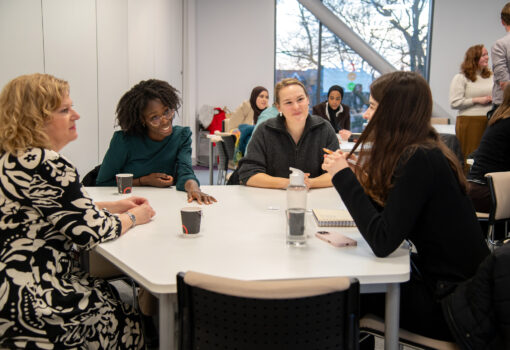
Browse our wide range of degree courses and find the perfect one for you.

Open days are the best way to find out what Lincoln Bishop has to offer.
Download your copy of our prospectus to find out more about life at Lincoln Bishop.