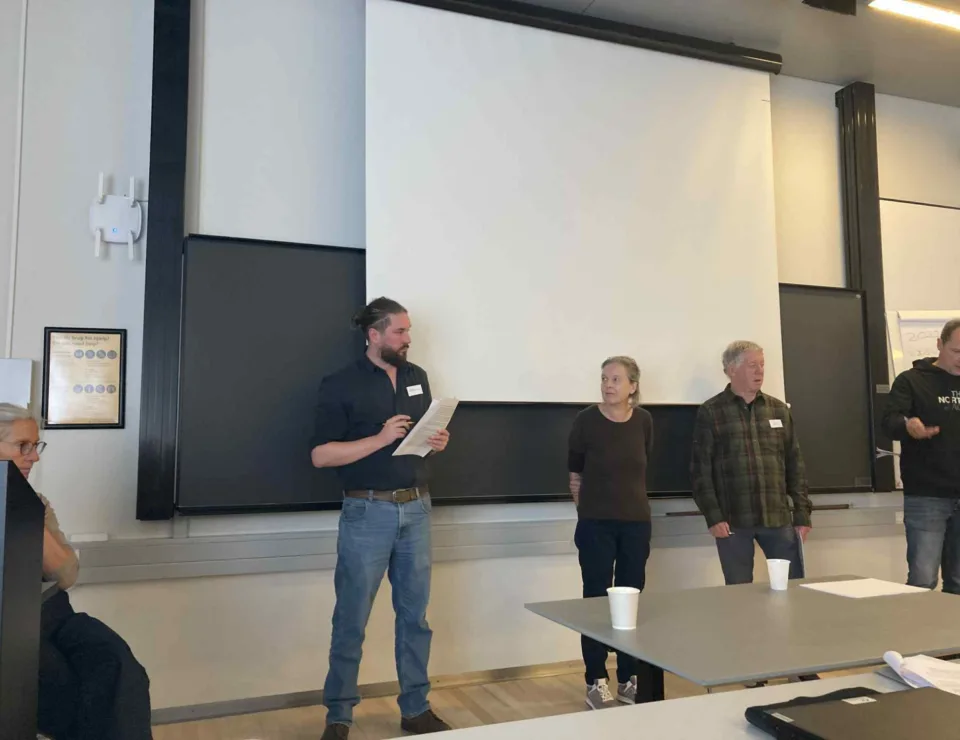
Alan Malpass, Senior Lecturer in Military History at Lincoln Bishop University, recently presented his latest research at the international conference From Warfare to Welfare? Resocialisation and Democratisation after World War II, held at the University of Southern Denmark, in Odense, from the 8th to 9th October 2025.
His paper, titled The Braintree Experiment: Introducing ‘the British Way of Life’ to German Prisoners of War (1946–1948), explored a little-known grassroots initiative aimed at re-educating young German Prisoners of War (POW) in Britain after the Second World War. While official re-education schemes have been well documented, Alan’s research sheds light on the Braintree Experiment; a local effort involving religious groups, educators, businesspeople, and politicians who sought to promote democratic values through social interaction and practical demonstration.
Focusing on Camp #180 at Radwinter, Essex, Alan examined how British civilians worked to present ‘the British way of life’ to POWs aged 25 and under, many of whom had known nothing beyond Nazism. The initiative complemented official policy and was welcomed by the Prisoner of War Department as a model of democratic community engagement.
Alan’s presentation offered a unique perspective on post-war reconciliation and democratisation, highlighting the role of local communities in shaping the attitudes of former enemies. His paper sparked thoughtful discussion among attendees, particularly around the legacy of such grassroots efforts and their relevance to contemporary debates on reintegration and transitional justice.
Reflecting on the experience, Alan said: “I was honoured to present my research at such a stimulating and well-organised conference. The range of papers was impressive, and I learned a great deal from the diverse perspectives shared by colleagues from across Europe and beyond. I’m grateful to the organisers for the opportunity to contribute and for fostering such a collaborative and insightful environment.”
Contributors to the conference were invited to submit written versions of their papers for inclusion in a forthcoming anthology, which will further explore the diverse approaches to resocialisation and democratisation in post-war Europe.
The conference featured over 20 papers across five themed sessions, covering topics such as reintegration, refugee resettlement, the resocialisation of collaborators, and post-war education and compensation. Contributors came from across Europe and beyond, including scholars from Denmark, Finland, Italy, Norway, Germany, and Australia, reflecting the international scope and relevance of the discussions.
The conference, supported by VELUX FONDEN, brought together historians and museum professionals from across Europe to examine how societies rebuilt and reimagined themselves after the trauma of war. Alan’s contribution added a valuable British dimension to these discussions.
To find out more about Military History at Lincoln Bishop, please click here!
Related Posts
International academics join MA SEND students for conversation and collaboration
Education and Early Childhood students gain global insights through Dutch university exchange
Amsterdam University of Applied Sciences returns to Lincoln Bishop for UKNL Conference 2026
International research article prize awarded to Lincoln Bishop colleagues
Lincoln Bishop academic attends global education conference

MA Education Team attend International Conference