As part of a self-set aspiration to visit all English Cathedrals (I have not included all four nations of the United Kingdom as I want to give myself the best chance of success and to not be thwarted by road, rail or other challenges) in July I travelled to Hereford.
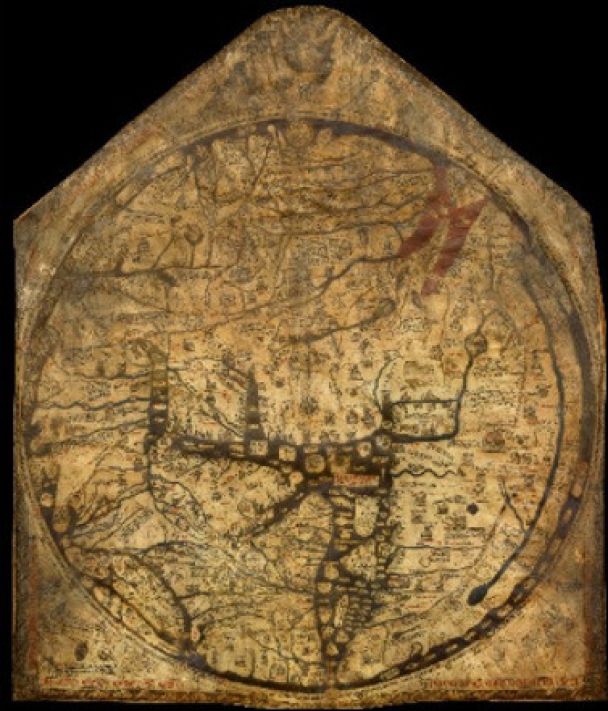
Hereford Cathedral is an ancient building dating back to the eighth century, although construction of the current building began in 1079. Reflecting this historic lineage it rightly, in my view, holds Grade I listed building status. It also houses two wonderful treasures: the Mappa Mundi which dates from the 13th century and has a specific connection to Lincoln, apparently being created by Richard de la Battayle who at one time had a prebendal stall in Lincoln Cathedral in recognition of his service to the diocese; and a 17th century chained library. Both of these artefacts are of particular interest for what they say about social justice and world views from this time.
The Mappa Mundi was made in a time when the global population was probably no more than 450 million people. Today, the world population is over 18 times larger at 8.3 billion people. Average life expectancy was around 35 and medicine for most was confined to folklore cures. Leisure travel was restricted to the very rich and there were only three known continents, Asia, Africa and Europe. The world as it was then, is unrecognisable to contemporary eyes and different values were evident. Christianity was in the ascendency and from its origins in Judea, was spreading to other parts of the globe. While a Eurocentric, westernised view still dominates the Mappa Mundi, the centre of the world was Jerusalem, the birthplace of Christ in the Middle East, part of the Asian continent. The defining feature of the world at that time regarding social organisation was not your ethnicity but whether you were Christian or not. While the Mappa Mundi represents people of Africa as monstrous, this was not based on their ethnicity, it arose from perceived godlessness. Racism as we know it today, a cultural expression based on visible phenotypes was not evident in the same way. Even though medieval narratives of needing to convert African peoples to Christianity were apparent, this was driven by religious views, not skin colour. This is a critical difference in the way people are perceived and valued because conversion to Christianity provided an opportunity for African peoples to be recognised as being of worth and through Christ, they could find salvation. Modern expressions of racism do not provide for this opportunity as it remains rooted in visible difference and there is no route by which people of colour can become part of the universal family of humanity. Therefore, medieval values seemed to provide a route for social justice, albeit rooted in Christianity, whereas modern racism provides no such option.
The chained library gives another perspective on social justice. Founded in the 1600s, literacy levels were unevenly distributed among social groups with the nobility enjoying relatively high levels of literacy while the lower social classes were largely illiterate. As it was assumed most women would either be wives or mothers, there was little reason to teach them to read and write, and they too were largely illiterate. Apart from the Bible, book ownership was rare and for lower social classes funds were not available to purchase books. Scholarly texts were expensive and there were limited numbers of libraries; those which did exist were normally attached to universities, making access to printed material the privilege of the elite classes. In this context, predictably, libraries sought to protect their resources and books were chained to bookcases and could only be read in situ.
The idea that books could be physically chained to one place seems odd in a digital age where any one of us can access vast ranges of text with a click and chained vellum texts become an anathema. The chained library also acts as a metaphor, where knowledge is only for the few and learning is restricted to identified chosen groups. While social media and digital platforms contain many inaccuracies, highlighting the imperative for us to continually employ our critical reading skills, the digital age has helped to make many more sources of information available to much larger audiences, giving the possibility of generating rich, multi-layered informed debates. The digital age, while perilous, is also precious, a wonderful gift which has the potential to enrich all our lives. As we move forward in the twenty-first century, let us try to remember access to learning was hard won and let us work to find ways to use each data source wisely for the benefit of all.