Over the last couple of years, I’ve worked with PGCE Drama trainee teachers on a scene set in Germany in the 1930s, from Fear and Misery of The Third Reich, by Bertolt Brecht, (Brecht, 2016), in which one of the characters, a history teacher, makes reference to ‘the brown house’. Named colloquially after Hitler’s ‘Brownshirts’ or Sturmabteilung (SA) – the paramilitary wing of the Nazi party, this was the headquarters of the National Socialist German Workers Party (NSDAP) on Breinner Strasse in Munich. The purpose built NS-Dokumentationszentrum (NS-Doku), opened on this site in 2015, to highlight Nazi exclusionary policies and practices and the war crimes and atrocities that followed, by showing how particular groups were first marginalised, then persecuted, and ultimately removed from public life through legal, social, cultural, and political mechanisms.
I visited the Munich Dokumentationszentrum in person this September; the suggestion is that you start on the fourth floor of the building and work your way back down. The documenting is meticulous, detailed, systematic, with visual displays and precise, restrained commentary in both German and English. Visitors were looking, listening reading, and absorbing, perhaps reflecting – no one was talking, the silence spoke forcefully of the unutterable. Some of the narrative of the period (and place) was familiar to me from what I have read and engaged with previously. I visited the memorials at Belsen concentration camp as a young teenager, Dachau concentration camp in my twenties, and later the Jewish Museum in Prague, including the exhibition of children's drawings from Terezín (Theresienstadt), and Sachsenhausen near Berlin, from where the entire system of persecution, exploitation, torture and murder was administered.
The NS-Doku highlights courageous acts of resistance, bears witness to millions of victims, but also exposes perpetrators alongside enablers. I learnt about Karl Alexander von Müller (1882-1964) a German historian. I’ll state the details here, as they are in the exhibit:
1933 Nazi party membership
1936 Professor of History at the University of Munich and President of the ‘Bavarian Academy of Science’ responsible for the expulsion of ‘non-Aryan’ members.
1945 removed from his position; pensioner
1953 member of the ‘Bavarian Academy of Fine Arts’
1959 Bavarian Order of Merit
The Bavarian Order of Merit is the highest general civilian honour awarded by the Free State of Bavaria since 1957. Recipients may be honoured for exceptional achievements in areas such as public service and politics, science and research, education, arts and culture. At the University of Munich, von Müller taught, amongst others Rudolf Hess and Herman Göring.
In contrast, the Bavarian Order of Merit was also awarded to Gerty Spies (1897-1997), the Jewish writer and Holocaust survivor from Munich, in recognition of her literary work, her testimony about the Holocaust, and her contribution to Christian-Jewish reconciliation in post-war Germany. Her receipt of the award reflected Bavaria's recognition of both her cultural achievements and her work preserving the memory of Nazi persecution. A panel in the permanent exhibition quotes her words:
What is the guilt of the innocent –
Where does it begin?
It begins there,
Where he stands to one side
Unperturbed, with arms relaxed
And shoulders shrugged,
Buttoning his coat,
Lighting a cigarette and saying:
There’s nothing we can do.
Look here, that’s where the guilt
Of the innocent begins.
Browsing in the NS Doku library through the catalogue of a previous, temporary exhibition To be seen. Queer Lives, 1900 – 1950, (Kühn and Zadoff, 2023), I read that the German Bundestag, Germany's federal parliament, officially included people persecuted because of their sexual orientation or gender identity, in its Ceremony of Remembrance for the Victims of National Socialism, for the first time in 2023.
I could see from the NS Doku that exclusion under the Nazis was not simply prejudice but a deliberate state project aimed at eliminating social spaces, organisations and identities considered incompatible with Nazi ideology. They regulated identities, decided who belonged and who must therefore, under their poisonous regime, be excluded. Exclusion operates through social, institutional and political structures rather than simply individual prejudice.
I sit at the café, reflecting on the intensity of my visit, quietly celebrating my presence as a queer academic on this site of the former Nazi HQ in Munich. I pledge in the NS Doku visitors’ book to take what I have experienced here forward in my work as an educator. As I leave, I am mindful that remaining committed to advancing the right to an inclusive education for all requires, as Professor Roger Slee has put it, ‘a lifetime subscription’ (Slee, 2019) and in homage to Gerty Spies, that is something we can do.
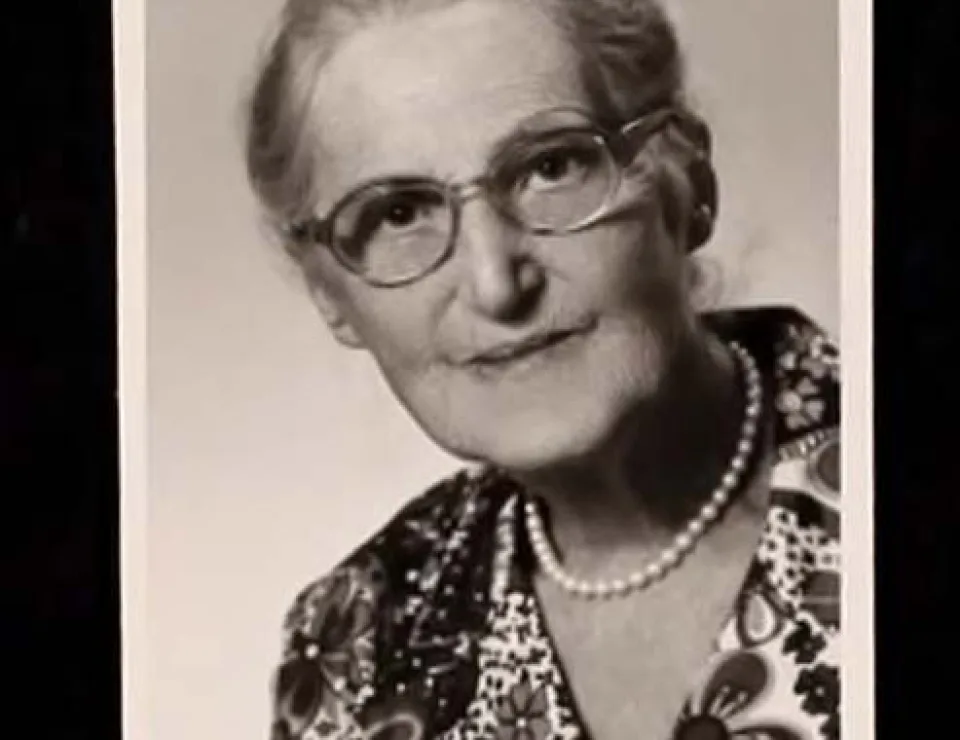
Photo: Gerty Spies, poet and survivor of the Theresienstadt concentration camp
References
Bertolt Brecht, Fear and Misery of the Third Reich, trans. by John Willett (London: Bloomsbury Methuen Drama, 2016), ‘The Spy’.
German Bundestag (2023) Ceremony of Remembrance for the Victims of National Socialism. Available at: https://www.bundestag.de/en/documents/textarchive/kw04-rememberance-930692 (Accessed: 10 September 2026).
Kühn, K. and Zadoff, M. (eds.) (2023) TO BE SEEN. Queer Lives 1900-1950. Munich: Hirmer Publishers.
NS-Dokumentationszentrum München. Gerty Spies (13.1.1897 Trier – 10.10.1997 München). Munich and National Socialism permanent exhibition, Max-Mannheimer-Platz 1, Munich. (Visited 2 September 2026)
NS-Dokumentationszentrum München (n.d.) Home. Available at: https://www.nsdoku.de/en/ (Accessed: 10 September 2026)
Roger Slee (2019) Belonging in an age of exclusion, International Journal of Inclusive Education, 23:9, 909-922, DOI: 10.1080/13603116.2019.1602366
Photo Citation