Search results
-
31.
Excellent student satisfaction
BGU is the second highest ranked public university in England for student satisfaction. Figures released today from the National Student Survey show that 92% of BGU students are satisfied with their university experience - that’s 7% higher than last year’s score and six percentage points higher than the sector average. Significantly seven courses reported overall satisfaction above 92%. Education Studies, Theology & Ethics achieved 100% satisfaction while three other courses – Early Childhood Studies, Primary Education with Recommendation for Qualified Teacher Status and Applied Studies – all recorded satisfaction levels of 97%. Dr Ruth Sayers, Executive Dean Learning, Teaching and International, welcomed today’s findings: “This is an excellent result for BGU and demonstrates our commitment to working in partnership with our students to improve their teaching and learning experience. We take what our students tell us very seriously and are always keen to hear what they have to say. We’ve introduced a number of initiatives to help give them a greater input including a new student engagement facilitator role which has been created to enhance and further develop a culture of staff and students working in partnership across the university. We’re also delighted with the overall response rate, which was 81% of eligible final year students, and would like to thank the Bishop Grosseteste Students’ Union (BGSU) for their support in encouraging people to take part.” BGSU President Kieran Parrish said he is thrilled with the outcome: “This shows that the students recognise the high quality of service they are actually getting from the university and that the relationship is one which is strong and transparent. From an SU point of view it is excellent to see how engaged and happy the students are, however, we know that there is always room for improvement. We are relishing the chance to build upon this and push ourselves to provide better for the students in the future.” The NSS statistics follow on from a succession of positive results for BGU. In April, the Quality Assurance Agency (QAA) published its review which found that BGU met its expectations in all areas – academic standards, learning opportunities, information and enhancement. In July, the Destination of Leavers from Higher Education survey revealed that BGU is one of the top three universities in the UK for student employability with 97.2% per cent of students who leave BGU with an undergraduate degree finding work or continuing to study six months following graduation. Also during the year, Ofsted gave a very positive rating for all of teacher education – early years, primary, secondary and further education – and praised BGU for having a “clear vision and an extremely strong commitment to their engagement with partners in the FE and skills sector”. The Reverend Canon Professor Peter Neil, Vice Chancellor of Bishop Grosseteste University, said it’s been an extremely successful year. “We’ve achieved some outstanding results this year which show that we provide outstanding facilities and support,” he explained. “It is also worth highlighting that we’ve recorded increases in all of the eight NSS question categories and attained one of the biggest rises in the country for overall student satisfaction. We conduct our own in-house survey every year and receive very positive feedback but it is very encouraging to see our students saying this in public. However, there is no room for complacency and we will keep growing the range of subjects on offer and further invest in improving our up-hill campus so that we can continue giving the students an excellent experience.” -
32.
Mother and Daughter Graduate Together at BGU
A mother and her daughter graduated together from Bishop Grosseteste University in Lincoln on Wednesday 20th July. Carol Bailey (57) and Sammie Steadman (31) graduated with a Foundation Degree (FdA) in Applied Studies (Early Childhood). They both work at the Sunshine Children’s Centre in Burgh-le-Marsh near Skegness and juggled their studies and full-time work during their two years at BGU. Carol works full time as a supervisor at the centre while Sammie is the Deputy Manager. Carol never thought she would study at university but the foundation degree was the right fit for her because it requires a minimum of two years’ experience of work with children in their early years. “My daughter and I were working 37 hours and a half per week and going to university in Lincoln from Skegness on a Monday. It was difficult and time-consuming as even the weekends were being taken up, but it was enjoyable at the same time,” said Carol. “We knew everyone else on the course was in the same boat and we would talk to each other as everyone was either in full-time work or doing 12 hours’ voluntary work. “I never thought I could do anything like this so it’s definitely a proud moment, and graduating alongside my daughter has made me even prouder.” Sammie has now decided to continue via the top up degree onto a BA (Hons) degree in Early Childhood Studies this September. “I was really happy to go to university with my mum. It takes us an hour to get there so it was nice to have that time together to catch up,” she said. “It’s going to be weird going back to BGU without my mum in September but I’m going back with people who I’ve already met in the past two years, so I should be fine. “My mum and I are grateful to BGU as all the lecturers were friendly and responded to all our emails.” -
33.
Lincoln Skyline to Feature on BGU’s Knight Sculpture
A pair of talented artists from Birmingham are putting Lincoln on the map by featuring the city’s iconic skyline on the knight sculpture being sponsored by Bishop Grosseteste University. Kieron Reilly and Lynsey Brecknell have called BGU’s statue ‘Knight and Day’, and it is one of 35 knights which will make up this year’s Lincoln Knights’ Trail celebrating the 800th anniversary of the Battle of Lincoln. The event organised by Lincoln BIG runs from 20th May until 3rd September and the knight statues will be unveiled at a launch evening at The Showroom in Lincoln on 27th March. As part of the trail BGU’s knight will be stationed near Newport Arch not far from the university’s campus. “Our design ‘Knight and Day’ shows off Lincoln’s beautifully unique skyline in silhouette form against a bold sunset, including our sponsor Bishop Grosseteste University,” said Lynsey. “Following the success of the Lincoln Barons’ Charter Trail in 2015 we’re sure that the Lincoln Knights are going to be loved by the locals and visitors from across the country, and we are proud to be a part of such an exciting project.” Kieron and Lynsey have very different artistic backgrounds: Lynsey has developed a career in theatre as a scenic artist and set builder while Kieron has a background in animation and now focuses on model making and design. They have successfully collaborated on many public art trails in the past and are looking forward to showcasing their design alongside the other sculptures on the Lincoln Knights’ Trail. “I’ve had a preview of our knight and it’s looking fantastic,” said the Reverend Canon Professor Peter Neil, Vice Chancellor of Bishop Grosseteste University. “We chose this design because we found it eye-catching and attractive, and also because it features the Lincoln skyline. The artists have adapted this to include the Skinner building on our campus in the silhouette, along with colours in the sky which fade up to BGU purple at the very top. “We think it looks wonderful and we’re looking forward to seeing it take its place as part of the Lincoln Knights’ Trail this summer.” Following the launch on 27th March each knight will be hosted by its sponsor to promote the trail, which will starts on 20th May – 800 years to the day since the Battle of Lincoln. The Lincoln Knights’ Trail is a Wild in Art event brought together by Lincoln BIG in partnership with Visit Lincoln and Education Business Partnership (EBP), in support of local homeless charity the Nomad Trust. Following a call for artists back in September 2016, over 200 innovative designs were submitted. A shortlist of 70 was drawn up and the artists given the opportunity to paint their design onto a miniature knight sculpture. The 35 sponsors then selected their favourite design. Following the trail the knights will be sold at auction at Lincoln Cathedral on 30th September. Two-thirds of the money raised will go to The Nomad Trust and one-third will help to create a new Art and Innovation Fund for Lincoln. The knights were designed and created by Wild in Art’s Creative Director Chris Wilkinson in the style of a chess piece. -
34.
Lincoln City FC link providing opportunities for BGU cheerleaders
Our partnership with Lincoln City Football Club benefits so many of our students, from coaching from the Cowley brothers for our Sports students to creating new opportunities for our cheerleading squad, the BGU Lions – it’s been a great year for everyone! The BGU Lions have had fantastic opportunities to perform in front of crowds of around 10,000 fans at Sincil Bank, not to mention live on BBC1 in the third round of the FA Cup. But it hasn’t stopped at the performance opportunities – the financial support has been an incredible opportunity for them. Cheerleading is an expensive sport to participate in, and BGU’s links to Lincoln City FC have offered some much needed financial support for the Lions. Louiscia Mcleod, President of the BGU Cheerleading Society, explains, “Thanks to our links at Lincoln City FC, the BGU Lions have been able to attend a national competition in which we placed second. It would've been tough (for us to attend) if not for their help.” Along with this support the link to the football club has allowed the BGU Lions to perform at Sincil Bank in front of thousands of fans and huge television audiences. Louiscia says, “It's an incredible experience! The fans are so lively and supportive. The atmosphere really just makes the whole night.” Along with performing at more Lincoln City games this season, the BGU Lions are focussing on the British Cheerleading Association (BCA) University Nationals on 14 April in Telford, where they’re hoping to bring back a trophy or two! On top of that, they will also be taking part in a showcase here at Bishop Grosseteste University, teaming up with Drama and other societies for a night of entertainment. Have you been inspired by the BGU Lions to take up cheerleading? Louiscia advises, “it's not all poms poms, glitter and bows. A lot of hard work and dedication is required. It's physically and emotionally demanding, you don't have to have any ability before joining as the team and coaches are there to support you and we all work together. “There's no better feeling than coming off the mat after smashing the routine. Coming from last season with a second place win at our first competition was just incredible. When you join cheerleading, you don't just get a great team of talented athletes, you gain a family.” Find out more about the societies on offer here at BGU. -
35.
Royal Visit to Mark Opening of Landmark Building at BGU
HRH the Duke of Gloucester will visit Bishop Grosseteste University in Lincoln next week to officially open the university’s latest new building. The £2.2 million extension to Constance Stewart Hall, which has created a new landmark building at the junction of Newport and Longdales Road, will be opened on Thursday 6thJuly. The works have doubled the size of the teaching block and involved building a steel-framed structure on top of part of the original building to give the university an additional seven teaching spaces set over two floors. This approach of building over an existing structure means that BGU will significantly increase its teaching space capacity without increasing the building’s overall footprint, which helps to maintain the green and open feel of the campus. During his visit to Lincoln on 6th July the Duke of Gloucester will also officially open the Battles and Dynasties Exhibition at The Collection. At BGU he will be introduced to dignitaries including the Bishop of Lincoln, the Right Reverend Christopher Lowson; the Mayor of Lincoln, Councillor Chris Burke; Lincoln’s MP Karen Lee; the Vice Chancellor of Bishop Grosseteste University, the Reverend Canon Professor Peter Neil; and the university’s Chancellor, Dame Judith Mayhew Jonas. On a tour of the campus the Duke will visit the university’s business centre BG Futures, the Victorian chapel and the new Centre for Enhancement in Learning and Teaching which opened in March. He will then officially open the new extension at Constance Stewart Hall by unveiling a plaque at approximately 2.45pm. A bold statement “This iconic addition to our estate really makes a bold statement in uphill Lincoln that BGU is an outward-facing institution,” said the Reverend Canon Professor Peter Neil, Vice Chancellor of Bishop Grosseteste University. “It’s further evidence of our ongoing commitment to invest in our teaching resources to ensure our students continue to have an outstanding experience.” Steve Deville, Director of Resources at BGU, said: “This fantastic new building reinforces BGU’s commitment to invest in our students and their learning experience. “This building is to be opened just a few months after our new Centre for Enhancement in Learning and Teaching facility and will provide students with flexible teaching spaces and state-of-the-art facilities to aid their learning.” The new teaching spaces will incorporate moveable partition walls, increasing their flexibility, meaning that they can be used not only for teaching but also for a variety of functions and events. Delivered by Lincoln-based architects LK2 and local construction company Robert Woodhead Ltd, the project was carried out in two phases and saw a 7,770 square foot extension added to the Constance Stewart Hall to accommodate new teaching space. The extension is supported by an impressive steel framework made from locally sourced steel and erected by Robert Woodhead Ltd. Throughout the project, contractors pledged to use local resources wherever possible. The project was procured through the empa framework which is managed by Scape Group. The development of the new building on campus was an opportunity to enhance the graduate attributes of BGU students, who were able to gain valuable work experience on the project with Robert Woodhead Ltd. -
36.
Professional Studies at BGU continues to grow
The Professional Studies Foundation Degree portfolio at BGU in Lincoln has grown with the introduction of a new study option. A newly validated pathway for 2017 called Professional Studies in Children and Youth Work with JNC complements the existing Childhood and Youth pathway. Students on this pathway can work towards professional accreditation for working with children, young people, families and their communities. Students need to successfully complete the Foundation Degree and Top Up Degree in Children and Youth Work alongside a portfolio of work-based evidence to achieve the Joint Negotiating Committee (JNC) professional status. Support is provided through a Fieldwork Supervisor and JNC qualified lecturers. The National Youth Agency (NYA) has recognised our Professional Studies in Children & Youth Work Degree for JNC accreditation. Find out more about Professional Studies in Children and Youth Work with JNC at BGU. -
37.
Clear Advice to Students from BGU on A-level Results Day
With A-level results day looming, Bishop Grosseteste University’s admissions team is poised and ready to guide students through the Clearing process. If you haven’t quite achieved the grades you need for your first-choice university or if you’ve done better than expected, it’s not too late to apply to through Clearing. That’s the message from Bishop Grosseteste University (BGU) which recently achieved an impressive 85% satisfaction rate in the National Student Survey. Notably students praised BGU staff for their level of availability when it came to supporting their needs, in addition to their ability to explain complex topics. The admissions team at BGU in Lincoln will be on hand to deal with enquiries during Clearing, which begins on Thursday 17th August when students across the country will receive their A-level results. The call centre will be open from 8am until 6pm on both Thursday 17th August and Friday 18th August and the number to call is 01522 583698. Prospective students can also visit the university at an open day on Friday 18th August from 10am until 3pm. The day provides an opportunity to see what Bishop Grosseteste University has to offer, take a minibus tour of Lincoln and speak to staff and students about courses and life as a student. To book your place on the Clearing open day, visit www.bgu.ac.uk/open-days “A-level results week can be a stressful and worrying time for students and their families, but remember that we are here to help and advise whatever your situation,” said Louise Stow, Student Recruitment Manager at BGU. “Our open day is also an opportunity for those who are starting (or hoping to start) in September to speak face-to-face to our staff about any anxieties they might have. “It’s a busy period for us but as always we will do our best to ensure that students are not left worried or uncertain about their place at university.” Top Tips for Clearing If you’ve just got your A-level results and you’re not sure what to do next, here is a handy set of tips for students who will be entering the Clearing system: Don’t panic! If you stay calm you’re more likely to take in all the information you need to succeed. Don’t panic! If you stay calm you’re more likely to take in all the information you need to succeed. If your grades fall short, wait for that important acceptance/rejection indication on track before you put yourself into Clearing. You never know – your first-choice university might still accept you. Don’t give up! You may well get a place on a similar course that’s just as good – but you’ll need to shop around. Don’t rush your decision. The UCAS system doesn’t even let you trigger the formal process of accepting a Clearing place until 5pm on results day, so you have the chance to shop around. Be realistic. If you’ve seriously blown it then think hard about re-sits or another course altogether – you can always re-apply next time around. UCAS is offering a free (for landlines) Exam Results Service on 0808 100 8000 where trained, professional careers advisers will be available to give help and advice Be prepared to make lots of phone calls and to be persistent! Keep your nerve – you may need all your negotiating skills to persuade an academic that they should take you on. Enlist the support of friends and family – keep them informed, as they’ll be a great help to you when you have to make that difficult final decision. Be prepared to explain to universities why you didn’t do as well as you hoped in your exams – and be honest. If you don’t get the grades you need it’s not the end of the world – there are plenty of other opportunities to consider. -
38.
Mother and Daughter to Graduate Together at BGU
A mother and her daughter will graduate together from Bishop Grosseteste University (BGU) in Lincoln on Wednesday 19th July. Sharon Tory (47) will be graduating with a Foundation Degree (FdA) in Professional Studies (Early Childhood) while her daughter Megan Tory (21) will be graduating with a BA (Hons) degree in Early Childhood Studies. The mother and daughter duo from Boston came to study together at BGU after attending an open day intended for Megan, who was looking for an early years degree programme. But Sharon had always wanted to be a teacher, and when she heard about the FdA Professional Studies course she knew it would be ideal for her. “I already work with young children at a pre-school and I didn’t think it would be possible to study for a degree alongside my job, but when I found out that the FdA course would allow me to do both I knew I had to consider it,” said Sharon. Megan started the three-year BA (Hons) Early Childhood Studies course in September 2014 and was the first in her family to go to university. “I never wanted to be too far away from home so BGU was the perfect choice for me living in Boston.” said Megan. After debating whether to go ahead or not, Sharon began the two-year FdA degree a year later in September 2015. Sharon said: “At the start, it was a bit of a challenge getting used to working and doing a degree at the same time, but overall the whole experience has been so rewarding. “I never thought I would be able to do it, so it’s definitely going to be a proud moment graduating alongside my daughter.” Sharon will continue her studies via the top up degree onto the BA (Hons) Professional Studies course this September at BGU, and follow on with a QTS course to become a teacher. Sharon Tory will graduate at 2.30pm and Megan Tory will graduate at 10.15am at Lincoln Cathedral on Wednesday 19th July 2017. -
39.
Unbinding Gender and Ecology—and Foucault!—at BAVS 2017
The theme of the 2017 BAVS Conference at Bishop Grosseteste University (BGU) was 'Victorians Unbound: Connections and Intersections'. Dr Pandora Syperek offers her thoughts... The ostensible theme of this year’s BAVS was the paradox between the parallel Victorian impulses to classify (knowledge, matter, people) into neat categories and to challenge established order and its inherent hierarchies through advancement and innovation. The goal was to consider what happens when the Victorians are ‘unbound’ from this seeming contradiction, instead granted the complexity to recognise that the one informed the other – the understanding of order and definition was necessary to blow it all apart and reorder and redefine. In order to do this we need to loosen the rigidity with which we have categorised the Victorians. In a way, this is a major thread running through my own research on the gendering of objects in the Natural History Museum, London: by looking at the less examined ‘jewel-like’ specimens on display—small, pretty, crafted, straddling art and science—and their resonance within the broader culture, I explore how categories of gender and genre were unstable and fluid. Like many Victorianists, I have been influenced by Michel Foucault’s History of Sexuality (1976) and its reconception of Victorian attitudes to sexuality and the epistemic implications. Foucault’s thesis in Volume 1 is that what has traditionally been characterised as the modern repression of sexuality, culminating in the notorious prudery of the Victorians—aka the ‘repressive hypothesis’—in fact reveals an explosion of interest in sexuality, hence the scientia sexualis of the late nineteenth century, which spawned the new field of psychoanalysis and the new ‘species’, the homosexual. Foucault’s notion that sexuality is a cultural construct had major impact, and followed on from his concept of the episteme—the historical conditions of possibility of a given discourse—as developed in The Order of Things (1966). Instead of the transition from sexual repression to sexual science, the latter focused on the transition from classical natural history to modern biology. While Foucault may no longer be the ‘hot’ theorist he once was, his ideas remain influential: I detected a strong Foucauldian thread running through the talks at BAVS 2017 and their unifying theme of Victorians Unbound. Here I will consider how the dual Foucauldian themes of sexual and natural science emerged—were unbound—in discussions of gender and ecology. Ghosts of The History of Sexuality and The Order of Things haunted the keynote lectures and roundtables that in turn lingered throughout the panel sessions and in delegates’ consciousness, but the phantoms seemed to reconfigure themselves into new forms. Let’s call it Foucault 2.0. The opening round table highlighted the importance of things: Kate Hill argued that museum collections and their treatment disrupt Victorian boundaries, with the hierarchies of objects echoing those of people. Edwina Ehrman beautifully literalised the conference theme in her talk ‘Unlacing the Corset’. Interesting to me was that WH Flower, the second director of the Natural History Museum, campaigned against corsetry—in my paper a couple hours later I would describe how he campaigned against women’s adornment with exotic bird plumage. Who knew comparative anatomists were so concerned with women’s fashion? While the disfiguring of women’s bodies through corsetry might seem similarly cruel and barbaric to the murder of innocent birds, the museum director’s opposition points towards a counter-regulation of women’s activities and self-adornment. This despite the fact that he was personally responsible for the killing of numerous specimens. Meanwhile, non-corset-wearing women like female activists were seen as unfeminine. This is the type of complexity that requires unravelling in contemporary scholarship.Mike Huggins’s jovial keynote on Victorian respectability established a running joke throughout the conference proceedings that carried with it a Foucauldian flavour. To understand the Victorian episteme(s), we need to acknowledge our own. While this may be an impossible task, asking historiographical questions of our work as Victorianists—e.g. why are we so obsessed with Victorian respectability? Why not Victorian unrespectability?—is essential for recognising how the current period and its concerns shape our vision of the Victorian era, and why it matters to us. The contemporary interest in the period in fiction and popular culture emerged in panels examining Steam Punk and NeoVictorianism, again questioning our relationship to the past via its representation in the present. The weight these areas were given marked an important development for Victorian studies and was fitting seeing as directly following the conference in Lincoln was a steam punk festival! These themes and Huggins’s talk set the tone for prioritising everyday realities and ‘low culture’ as much as high discourse. I’d have to say the most revealing experience for me was a tour of the Victorian Prison following the drinks reception on the beautiful grounds at Lincoln Castle—descriptions of cell conditions for inmates including children and women with babies, as well as public hangings, brought home some of the grimmest aspects of Victorian life. As well as topics of gender and natural science, as an art historian I was drawn to the art and visual culture panels—luckily for me, a number of talks combined these fields. In the panel ‘Sex, Sexiness, Sexlessness: Problems of Eroticism in Victorian Classical Forms’, Rebecca Mellor and Melissa Gustin’s papers examined how queer sexuality can and has been both overemphasised and underemphasised, respectively, to the detriment of art historical narratives in the cases of Pre-Raphaelite painter Simeon Solomon and American Neoclassical sculptor Harriet Hosmer. The artists’ gender is implicated here, in that art historians have traditionally overlooked beauty as the embodiment of intellectual and spiritual ideals in Solomon in favour of an oversexed reading of homoeroticism, according to Mellor, while Gustin argued—in her excellently titled paper ‘Fifty Shades of Gay’—that conversely art historians have tripped over themselves to ignore and deny Hosmer’s lesbianism and its influence on her work. The consensus was to reclaim the queer gaze whilst broadening our conception of the erotic to go beyond the physical. While contemporary theories of gender and sexuality can facilitate new understandings of such material, a historicised conception of sexual categories, à la Foucault, is essential.Also on the positioning of gender in between lived experience and representation, in their panel ‘Transgender’, Ann Heilmann, Billie-Gina Thomason and Rachel Egloff discussed transgenderism in Victorian lived realities and textual personae. A recurring problem was the privileging of ‘biology’ in both historical and current discourse—e.g. the Victorians’ determination of gender through breasts and external genitalia, and recent biographers’ insistence that James Miranda Barry was female, despite living as a man for over fifty years. As with the panel on queer artists, unpacking trans histories brings up important methodological questions for how we address these histories whilst, as Thomason urged, avoiding the problem of presentism—imposing our current understanding, or episteme, on the past. And yet this does not only comprise current debates such as those surrounding trans rights, but equally broader categories developed during the Victorian era, such as modern biology.Subtler modes of categorisation were explored in panels such as ‘Decadent Spaces/Pleasurable Places’, which featured Joanne Knowles on the geographically and socially liminal space of the pleasure pier, Joseph Thorne on marginality and hybridity in Decadent cosmopolitanism and Giles Whiteley on the ‘curious effects’ of Wilde’s psychogeography. Rayanne Eskandari and Stuart McWilliams discussed the ‘Politics and Medievalism’ of John Ruskin and William Morris, respectively, and their paradoxes of authority and subversion in the case of Ruskin, and populism and scarcity in the case of Morris. In one of the few explicitly art focused panels, ‘Sculpture: Connections and Intersections’, Katie Faulkner discussed the gender and genre performance of Julia Margaret Cameron’s photography, as engaging with both sculpture and theatre to construct a particular vision of femininity. Jordan Kistler reconsidered evolutionism in Walter Pater’s theory of artistic development as representing a taxonomy based on the Lamarckian archetype, as promoted by Richard Owen (founder of the Natural History Museum) rather than an illustration of Darwinian progress. The implication, according to Kistler, is that in Pater’s formulation sculpture may come out favourably, as the epitome of art rather than its lowest form. In my own panel, simply titled ‘Objects’, Leonard Driscoll discussed things unrealistic but real in HR Haggard’s paratexts, taking the discourse of naturalism beyond the literary genre (which Haggard found rather ugly and smelly) to explore liaisons with archaeology. While the ‘connections and intersections’ between Leonard’s paper and my own on gendering taxidermied hummingbirds were not immediately obvious, parallels concerning the real or more-than-real and corresponding issues of taste and authenticity quickly emerged between these historically marginalised artefacts. Throughout BAVS 2017 there was an emphasis on the everyday and its objects. As Kate Flint stated in her beautifully illustrated keynote on the cultural history of dandelions: the attention to the ordinary, commonplace and overlooked was one of the Victorians’ greatest contributions. This sentiment was echoed in the final President’s Panel speakers Katherine Newey’s enthusiasm for studying theatre with its liberating marginality and infinite materiality and Brian Maidment’s call for more studies of songbooks and almanacs and the need to experience archives in the flesh. This theme was fostered by, and in turn facilitated, a sense of fluidity or boundlessness of disciplines. And yet disciplinary demarcations were still apparent in different approaches taken, confirming there is still much to be learnt from one other. As a non-literary studies person, I felt like a tourist. But then again maybe that’s why I enjoyed it so much. The historian Peter Gay has written that Foucault’s ‘accustomed technique…of turning accepted ideas upside down’ is reminiscent of the principle underlying Oscar Wilde’s humour. This method is as relevant now as it was to the Victorians.Pandora Syperek is a postdoctoral researcher who recently completed a fellowship at the Paul Mellon Centre for Studies in British Art. She is developing a monograph titled Jewels of the Natural History Museum: Gender, Display and the Nonhuman, 1851-1901. She received her PhD in the History of Art at UCL in 2015. -
40.
Darcey Bussell brings DDMIX programme for schools to BGU
Ballerina and Strictly Come Dancing judge Darcey Bussell visited Bishop Grosseteste University (BGU) in Lincoln today to speak to trainee teachers about DDMIX for Schools. Darcey and her DDMIX team worked with over a hundred trainee teachers from Primary and Secondary programmes from the School of Teacher Development at BGU. DDMIX is a full-body aerobic workout for children created by Darcey Bussell and based on 26 different dance genres, from Arabic and Japanese to the Charleston and the Flamenco. The day opened with a special lecture for all year groups where Darcey introduced the programme. Students then split off into smaller groups to participate in sessions with the DDMIX team. Speaking about DDMIX Darcey said, “Movement to music makes children come alive and changes the way they feel. With the DDMIX programme, children get an exciting and diverse learning experience that is physical, aerobic and high time on task. These benefits should be enjoyed by every child. “Dance fitness can stimulate the child’s interest in sport, in the arts and give them the confidence to explore their own creativity in other fields." An Amazing Experience DDMIX came to BGU through the work of Helen Thornalley, Subject Leader for PE and Dance for the PGCE Secondary course at BGU, who arrived at the University in January. Helen has worked with Darcey and DDMIX for the past three years on training teachers and reflecting on how this work is implemented within schools. Feedback from the trainee teachers is vital for DDMIX to find out what works for children in schools. Helen said: "The opportunity for trainee teachers to work with these professionals who are at the top of their game, and the sharing of their materials with prospective teachers for schools is amazing. “(It was) unique, rich and cathartic for all involved, a very exciting project that I have seen teachers embrace and make it their own." Members of the DDMIX team introduced BGU students to a range of different dances and activities that can be utilised when students go into schools on placements. Jessica Castro, first year BA (Hons) Primary Education with QTS student, was full of praise: “The session was really good. I thought it was great how they split everything up into sections, which will help us with how to teach the children. “They haven’t just thrown us into the deep end, they’ve shown us how to work with the children and taught us the dances as well so I thought that was really clever. “I’d love to use (DDMIX) in schools. When we go into placements and we have to use PE I’d definitely use something like this rather than what you’d expect PE to be.” Find out more about Training to Teach at BGU.
Explore Lincoln Bishop
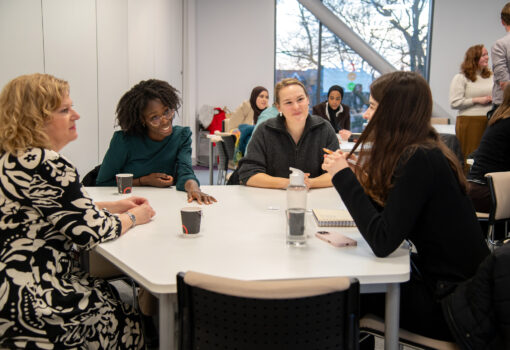
Browse our wide range of degree courses and find the perfect one for you.

Open days are the best way to find out what Lincoln Bishop has to offer.
Download your copy of our prospectus to find out more about life at Lincoln Bishop.