Search results
-
301.
WRERU - World Religions and Education Research Unit
Our research projects are at the heart of WRERU’s work, driving fresh thinking, meaningful collaboration, and real-world impact. Bringing together scholars, educators and partners, these projects explore some of the most pressing and thought-provoking questions in world religions and education today. Spanning diverse traditions, contexts and approaches, they not only generate new knowledge but also shape practice and deepen public understanding. From collaborative research to innovative pilot initiatives, each project reflects our commitment to work that is both intellectually rigorous and socially relevant. -
302.
Remembering 9/11 Twenty Years On
On the morning of September 11, 2001, an American Airlines Boeing 767 crashed into the north tower of the World Trade Center in New York City. Worldwide, millions watched in shock as events were broadcast by live television coverage. Many remember the chilling footage of the second plane hitting the south tower and the later collapse of the twin towers. At 9.45 am (Eastern Standard Time - EST), a third plane hit the Pentagon in Washington D.C. At 10.10 am (EST), a fourth hijacked plane crashed in a field in western Pennsylvania. United Flight 93 had been delayed leaving Newark Liberty International Airport, leaving time for some of its passengers to learn of the attacks in New York and Washington from cell phone calls. A group of brave passengers and flight crew fought the highjackers preventing the terrorists from weaponising the plane and taking out their fourth intended target, either the White House or the U.S. Capitol. The coordinated attacks were carried out by the Islamic extremist group al Qaeda. Nearly 3,000 people lost their lives that day. Twenty years on, historians at Bishop Grosseteste University share their memories of a day that changed the world. Dr Claire Hubbard-Hall, Programme Leader for Military History. I was weeks away from submitting my Master's' dissertation when 9/11 happened. The day the planes hit the World Trade Center, I had broken away from editing a dissertation chapter. I made a sandwich and then switched on the weighty analogue box television that occupied the living room corner. Images of destruction and devastation greeted me. News of the attacks in New York dominated both BBC and ITV channels (two of just five channels then). For the rest of the day, I sat transfixed, unable to make sense of the news that followed. In an era before social media, the live broadcast made it feel as if I were there. I watched in horror as the Twin Towers plummeted to the ground. At the time, I felt sick. Looking back, I still do. During my doctorate, I spent some time in New York as a Fritz Halbers Fellow researching aspects of the Holocaust at the Leo Baeck Institute. In 2006, on a bitterly cold January morning, I visited the site of the 9/11 attack. Standing silently in Lower Manhattan, I felt overwhelmed with emotion, still unable to process the unthinkable. As we mark the 20th anniversary of one of the deadliest terrorist attacks in history, I wonder how much 9/11 is shifting from lived experience to a historical event connected to the years of history before and after the 9/11 attacks. Dr Hazel Kent, Lecturer in History. I was rushing from my classroom to the staffroom to grab a much-needed cuppa after a busy lesson (some things don't change). A colleague stopped me in the corridor: "Have you heard what's happening in New York?" I hadn't. There wasn't easy internet access in a Lincolnshire comprehensive at that time, and certainly not in my History classroom. I went over to the Science block, to the technician's long, thin preparation room; this was the only place in the school with a live television signal. Surrounded by the chemical bottles and equipment, I remember watching the coverage in disbelief and trying to make sense of what was happening as more and more staff crowded into the tiny space to do the same. I remember the confusion as TV reporters tried to explain, as the horrific trauma of a carefully coordinated terror attack began to unfold thousands of miles away. Watching the coverage of the event certainly had a profound effect on me. From a historian's point of view, it is interesting to reflect on the experience of watching such a significant event unfold in real-time before its narrative has been created. Dr Alan Malpass, Lecturer in Military History. I've lived my entire adult life in the post-9/11 world, but my memories of that day are hazy. I do remember, quite vividly, sitting on the sofa in my parents living room watching news reports of the attack. I had just returned from school, so it must have been around 4 pm (BST). My dad was still at work, but my mum was watching the TV. I remember walking in and seeing her stood in the middle of the room. I immediately felt that something serious had happened, and I sat down. I don't remember us speaking a lot, but just sitting and trying to comprehend the news coverage. I didn't understand what had happened – I don't think anyone did at that point. I'd never heard of the 'Twin Towers' or thought much about terrorism, but the chaotic images made an instant impression. The sense that something tragically earth-shattering had happened was clear. Twenty years later, I now find myself teaching the events of 9/11 and terrorism on some of the modules I deliver. They are requisite to understanding the world we live in today. Further information about the 9/11 Memorials can be found at The 9/11 Memorial & Museum, Flight 93 National Memorial and The National 9/11 Pentagon Memorial. -
303.
Dr Amy Webster
Amy joined Lincoln Bishop in the summer of 2020 as a Senior Lecturer in Education Studies after finishing her PhD at the University of Cambridge. She has a BA (Hons) in Education with Primary Qualified Teacher Status from Durham University and an MPhil in Education with distinction from Cambridge. She was also previously an Associate Lecturer at Anglia Ruskin University. Her doctoral project focused on the historical recovery and analysis of British series of children’s classics using digital humanities methods, particularly historical shifts in the titles included in series and how these classic works have been abridged and repackaged since the turn of the twentieth century. Amy is part of the Literature and Literacies (LiLi) Research and Knowledge Exchange Unit and is co-editor of The Four Corners, Lincoln Bishop’s newsletter on children’s literature. She teaches on the Education Studies undergraduate programme as well as the new MA in Children’s Literature and Literacies. She also supervises dissertations on the MA in Education. -
304.
BGU Signs Up to Gender Equality Charter
Bishop Grosseteste University has signed up to a charter used to transform gender equality within higher education. The Athena Swan Charter, an international framework used to address gender equality and barriers to progression that affect women, was officially adopted by Bishop Grosseteste University – Lincoln this month. By being part of the Athena Swan Charter, Bishop Grosseteste University is committing to adopting ten key principles within their policies, practice and culture, which promote gender equality. Originally established in 2005 to encourage and recognise commitment to advancing the careers of women in science, technology, engineering, maths and medicine (STEMM) employment, the Charter is now being used across the globe to address gender equality more broadly. Deputy Vice-Chancellor, Professor Scott Fleming said: ‘We’ve launched the formal part of our Athena Swan journey at a time when the Charter has just been transformed. It is now more streamlined, flexible, transparent and consistent. There’s already been a lot of work to get us to this point but we still have a lot to do. The team is eager and committed; it’s an exciting time for BGU.’ The University hopes to enter an application for the Bronze Athena Swan Award in the academic year 2022-23, following a year of self-assessment. Dr Aimee Quickfall, Head of Programmes for Primary ITE, said: ‘As chair of the BGU Athena Swan self-assessment team, I am very pleased that the project is now underway with the signing of the charter. Behind the scenes, we have been delighted with the level of response from the BGU team, with representatives from Faculty, Professional Services and the student body volunteering to be part of the self-assessment core team and a consultative group. The wealth of experience and expertise offered is fantastic, and it is clear that there is a real passion and enthusiasm for the Athena Swan project.’ The project has received strong support from Bishop Grosseteste’s Human Resources team. ‘As Director of HR I am delighted we have formally started our Athena Swan journey. Behind the scenes, the group chaired by Dr Aimee Quickfall has been working extremely hard to ensure the University is in a position to start this project. As a university we are committed to making positive changes around gender equality, committing to the Athena Swann charter is a positive step forward for BGU, ensuring we adopt key principles within our practices and culture to positively promote gender equality,’ said Jonathan Cheeseman -
305.
Social Justice - RKEU
Lincoln Bishop University’s research cluster aims to explore, promote, and advance social justice through education by challenging inequality, understanding discrimination, supporting inclusive practices, and producing impactful research and collaborations within and beyond the university community. -
306.
Dr Amanda Arbouin
Dr Amanda Arbouin joined Lincoln Bishop University as an Honorary Senior Fellow in Education Studies in August 2021. She has expertise in the Sociology of Education, with a particular focus on the effects of race, class and gender in education and employment. -
307.
Dr Ursula McKenna
Dr Ursula McKenna is Senior Research Fellow in Implicit Religion at Lincoln Bishop where she is located within the Department of Theology and the World Religions and Education Research Unit. Upon completion of her BA (QTS) she was awarded an Economic and Social Research Council MA studentship and obtained an MA (with distinction) for her work on religious education for children with special educational needs in the primary school. While combining a part-time research post with a job-share class teaching position she then completed her doctorate. Her research was an evaluation of the Building E- Bridges programme, a project which advocated the use of email in primary schools to promote interfaith dialogue amongst pupils across the UK. For fourteen years Ursula taught across the primary age range and as research fellow at the University of Warwick (1999-2021) she contributed to the PGCE Primary and Early Years Religious Education module and the MA in Religious Education by distance learning course. She has undertaken supervision of dissertation students on BA and MA Education Studies degrees and has co-supervised research students. For twelve years she was editorial assistant for the British Journal of Religious Education, co-ordinating the refereeing process for all submissions and special issues. -
308.
Bishop Grosseteste University ranked 2nd position in Top 10 Universities in the country for social inclusion
Bishop Grosseteste University has been announced 2nd in the top 10 ranking for social inclusion in the country in this year’s Sunday Times Good University Guide. -
309.
Reflections on Black History Month at BGU
Throughout October, Bishop Grosseteste University hosted a month-long programme of free events to celebrate Black History Month. The events included academic lectures, story-telling session and exhibitions that highlight the contribution of Black poets, educators, activists, athletes amongst others during this global month of celebration. Each of these sessions were designed to be educational, but also to engage and entertain in different ways while challenging received ideas and knowledge and were available to staff, students, guests and the wider public via live-stream where applicable. Dr Sheine Peart, Reader in Access, Equality and Inclusion and Project Lead for Black History Month at BGU, said: “As we reach the end of October I would like to offer some personal reflections on Black History Month at Bishop Grosseteste University 2021 which has been a resounding success in countless different ways. “The month-long programme of events was planned by a multidisciplinary University wide team and from the outset the ambition was (borrowing words from the BBC charter) to entertain, educate and inform while at the same time celebrating the multiple ways the global community has been enriched by contributions of people’s from the African diaspora. Benefiting from the skills and knowledge of University colleagues and invited contributors, each event fed into this ambition and provided new insights to the participating audiences while simultaneously honouring the common bonds which unite us and engaging with the challenges which confront us. “Through poetry, music, song, film, thought-provoking talks and story-telling sessions the audience learned of the ways Black peoples had enriched local, national and international communities including the innovative education strategies of Beryl Gilroy (the first Black Headteacher in London) and the ways the Reverend Sonia Baron in her work with the national government is currently challenging inequalities in work based and other spaces to provide better opportunities for everyone. “BHM at BGU will return in 2022 with another programme of events which will be open to students, staff and the wider public. We look forward to welcoming you to our next celebration and invite you to keep watching for future announcements.” -
310.
Revd Canon Professor Leslie J Francis
Leslie Francis holds the part-time post of Professor of Religions, Psychology and Education. He works with doctoral students in fields that connect religious studies, theology, psychology, and education. Before joining Lincoln Bishop University he held chairs in Pastoral Theology at Lampeter, Practical Theology at Bangor, Religions and Education at Warwick, and Religions and Psychology at Warwick. Currently he holds visiting positions in universities in Pretoria and Newfoundland and serves as Canon Theologian at Liverpool Cathedral.
Explore Lincoln Bishop
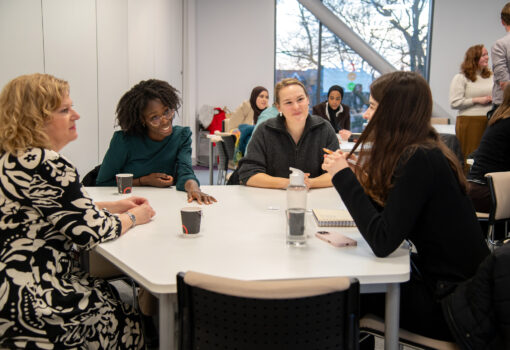
Browse our wide range of degree courses and find the perfect one for you.

Open days are the best way to find out what Lincoln Bishop has to offer.
Download your copy of our prospectus to find out more about life at Lincoln Bishop.