Search results
-
21.
1st for Academic Support (History)
-
22.
BGU history lecturer reveals hidden stories about women in the publishing trade
Dr Rose Roberto, Lecturer for History at Bishop Grosseteste University and Teaching Resources Librarian has co-edited a two-volume collection of research on women's history named Women in Print. The research covers the diversity of roles women played as authors, designers, producers, distributors and readers of books from the 1400s onward. To a greater extent, the history of the printing and publishing trades in the West which has been dominated by narratives of men, despite women always having been involved. From cloistered nuns who served as scribes and illuminators for codexes we now call textbooks that were distributed in medieval university cities, to eighteenth century widows and daughters who created art and managed family engraving or printing firms, to women employed as translators, illustrators, authors and photographers during the industrial age, these two volumes, which compile the historical research of an international group of scholars setting the record straight. Women in Print, are part of the ‘Printing History and Culture’ series published by Peter Lang. Women in Print 1: Design and Identities contains eleven chapters incorporating case studies of design aspects of a printed work, or more broadly about design issues related to the business of publishing. Edited with Artemis Alexiou (York St John University) both editors have selected chapters which focus on specific individuals and their career as female artists, compositors, editors, engravers, photographers, printers, publishers, scribes, stationers, typesetters, widows-in-business, and writers. Each chapter also offers an examination of women as active participants and contributors in the many and varied aspects of design and print culture, including the production of illustrations, typefaces, periodical layouts, photographic prints and bound works. This volume explores the visual material that they produced. The second related volume, Women in Print 2: Production, Distribution and Consumption contains selections covering professional relationships between two or more women or a business network in which aspects of their roles in production, distribution and consumption of the printing trade are explored and further analysed. It was co-edited by Caroline Archer-Parré of Birmingham City University and Christine Moog of the Parsons School of Design in New York. Series editor John Hinks is also credited because of his work organising the conference and guiding the manuscripts through delays, mainly caused by two years of a world-wide pandemic, to publication. Chapter 6, 'Working Women: Female Contributors to Chambers’s Encyclopaedia’, authored by Rose Roberto reflects her discovery of women writers and the exploration of archives spanning Philadelphia to Edinburgh, and London to Manchester. So far she has uncovered 25 female encyclopaedia contributors. Besides reflecting on the lives of these women and how they came to participate a transatlantic encyclopaedia project spanning more than three decades, this chapter also traces the evolving process whereby women achieved status as professionals throughout the 1800s as various fields in different trades developed. Some names in this chapter such as Florence Nightingale (1820-1910) and Millicent Garrett Fawcett (1847-1929) are familiar. Others are less-known, but just as interesting. According to the editors of the Romantic Illustration Network (RIN), 'While most histories until the last forty to fifty years often treat women’s histories "as outstanding anomalies" in cultural and professional fields dominated by men, the aim of the scholarship in this collection . . . show that women were always present. It approaches the lives of women – and writing about their lives – as part of a process which reveals complex individual histories.' Both volumes are available for BGU staff and students at the BGU Library. Or you can purchase your own copies at the Peter Lang website. Dr Rose Roberto with the new publications -
23.
Archaeology and History with Foundation Year
Studying Archaeology is ideal if you’re fascinated by both the ancient and more recent past and if you want to explore and investigate the material remains of previous societies and cultures. It will allow you to get hands-on with the past and explore civilisations and people from throughout history, in a practical and interesting way. If you don’t have, or don’t think you will attain the normal tariff points for studying at Lincoln Bishop, click here to view the Foundation Year version of this course. -
24.
English and History with Foundation Year
Studying English Literature at Lincoln Bishop offers an exciting and wide-ranging exploration of the power of human creativity and the rich heritage of literary expression. On this course, you will encounter great works of literature by authors from Ovid to Ali Smith, and from Shakespeare to Bernardine Evaristo, Salman Rushdie, and Chimamanda Ngozi Adichie. Your studies will be enriched by opportunities to explore creative and environmental writing, detective fiction, world literature, drama, children’s literature, film, and literature from the Victorian, Romantic, and contemporary periods -
25.
Artefacts, Not History: the debate about Colston's statue and Britain's imperial past
Dr W. Jack Rhoden, Programme Leader for History at BGU, discusses the role of statues in the study of history -
26.
Lecturer’s new article reveals the early history of book collecting by the Cavendish family
Dr W. Jack Rhoden, Programme Leader for History at Lincoln Bishop University (Lincoln Bishop), has had an article published in the Midland History journal outlining the early history of book collecting by the Cavendish family. The article, the first such study of its kind, seeks to reveal the extensive book collecting activities of one of the most wealthy and powerful aristocratic families of early modern England. It analyses the early modern book collecting activities of the Devonshire branch of the Cavendish family as an example of elite cultural capital accumulation across multiple generations. Speaking following publication, Dr Rhoden discussed what readers and prospective students could expect from the article: “The article will be of interest for those who like book history along with anyone who has visited Chatsworth House and Hardwick Hall and has a general interest in the history of the Cavendish/Devonshire family. It is also linked to our level 4 module - HIS404: British Libraries, Museums and Archives: A History of Collection, 1600-2000 which provides a general history of British libraries, museums and archives from the collections of wealthy individuals in the early modern period to more middle and working-class collections and the ultimate establishment of state-supported national and public institutions from the mid-18th century to the present day beginning with the British Museum.” The article, which is now available here to online subscribers of the Midland History journal, is the product of work originally undertaken during Dr Rhoden’s time as a post-doctoral researcher at Chatsworth House, Derbyshire. You can read his full series of blogs, which delve into the intriguing history of a library that has evolved over 400 years, by clicking here. -
27.
Students discover early history of BGU
History students from Bishop Grosseteste University (BGU) in Lincoln have delved into archives of student magazines to uncover BGU’s roots as a training college. The project, led by lecturer in History Dr W. Jack Rhoden, saw a group of four BGU History students work with BGU archivist Guenever Moyes to digitise and record a run of student magazines from the late 19th and early 20th century. The magazines were written and self-published twice a year by the female students of Lincoln Diocesan Training College (the college was renamed Bishop Grosseteste College in 1962 to mark its centenary) and contain a wealth of insights and information about life at the College. The first edition is from 1895 and there are contributions from former students and discussions of College history going all the way back to its foundation in 1862. We learn from these magazines that there was already an association of past members set up in 1892. The team also discovered that in its first 30 years the College produced nearly 700 students who went on to practice their profession and settle all around the globe, from North America to Australia, India and southern Africa. There is a plan to use these student magazines to inform a temporary exhibition at the British Association of Victorian Studies (BAVS) conference in mid-August 2017, and a more permanent exhibition of College history on campus in the near future. The aim of which will be to inform current and future students of the rich history of BGU as an educational institution with global reach and impact. Dr W. Jack Rhoden said, "Preserving and working on these magnificent magazines is a real privilege. They provide a window into the lives of the many ordinary women who went on to achieve extraordinary things as teachers and missionaries across the world." The project is in its early stages and is just the first of many seeking to digitise and promote the exceptional College records contained in BGU archives. Found out more about History at BGU. -
28.
Black History Month 2024 at BGU!
A summary of BGU's Black History Month, hosted across campus this October. -
29.
In memory of Margaret Elwell: one of the first history lecturers at Bishop Grosseteste University
Stories from the history of Bishop Grosseteste University are being told in a series of blog posts. In this instalment, Abigail White researches one of the first people to teach history a BGU. -
30.
98% positive response for Teaching (History)
Explore Lincoln Bishop
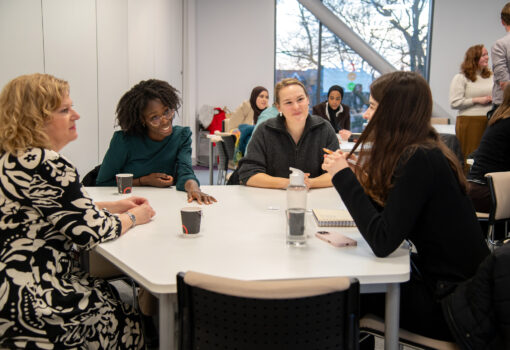
Browse our wide range of degree courses and find the perfect one for you.

Open days are the best way to find out what Lincoln Bishop has to offer.
Download your copy of our prospectus to find out more about life at Lincoln Bishop.