Search results
-
241.
How long do influenza pandemics normally last?
Dr Andrew Jackson, Head of Research at BGU, has published a series of articles exploring how the current circumstances in which we find ourselves offer a window into the history of both Lincoln and the wider United Kingdom*. In the third of these he explores what we can learn from previous influenza pandemics. -
242.
How government health advice has, or hasn’t, changed in the last 100 years
Dr Andrew Jackson, Head of Research at BGU, has published a series of articles exploring how the current circumstances in which we find ourselves offer a window into the history of both Lincoln and the wider United Kingdom*. In the second of these he examines how government health advice has, or in this case hasn’t, changed in the last 100 years. -
243.
Why adults shouldn't rule out children's book from their reading lists
As the country, along with the rest of the world, settles into the possible new normal of social distancing and working from home many are beginning to plan out long lists of exciting potential reads to keep them occupied. These may be well loved classics or unknown literary adventures but the likelihood is that they will be books designed for adults. However, as Dr Mary-Louise Maynes, Senior Lecturer in Early Childhood Studies at Bishop Grosseteste University (BGU) and one of the academics on the new MA in Children’s Literature and Literacies, explains adults shouldn’t be ashamed to include some children’s books in their choices too. On reading children’s books (as an adult) Browsing the adult fiction shelves of Waterstones recently I noticed that the Harry Potter books have yet another new cover without any sign of the boy wizard. This is presumably so that you can read the books on the train without looking silly: without looking as if you are reading a children’s book. Adults read children’s books, but still, it seems, reading them makes many of us rather uncomfortable. As we launch our MA in Children’s Literature and Literacies here at Bishop Grosseteste University, I want to explain why I read children’s books and why I think more adults should too, and not apologise for doing so. They are good ‘reads’… Children’s authors know that children are exacting critics. Junior-aged children in particular (generally) enjoy books which are plot-driven, gripping and engaging from the start, well-paced, and which use cliff-hangers at the end of chapters to make you want to read on. If you want to lose yourself in a thrilling story or a page-turning adventure look no further than a good children’s book such as The Invention of Hugo Cabret (Selznick, 2007) or The Explorer (Rundell, 2018). In literary terms to describe a text as plot-driven often implies a lack of depth and quality, a criticism often levelled, unfairly, at children’s literature as a whole. Many children’s books present examples of beautiful and lyrical writing where there is much to explore below the surface and which invite re-reading. Take for example the slow, ‘outsider’ reflections of the Fox in Pennypacker and Klassen’s Pax (2017) or the haunting, puzzling and disturbing words and images in Shaun Tan’s The Red Tree (2010). They have pictures…. Children’s picture books, non-fiction and poetry will introduce you to the work of some of the most innovative and diverse artists and the images are every bit as important as the words. Children’s illustrators have distinct visual styles and employ a range of artistic techniques: contrast for example Beth Waters’ striking monoprints in A Child of St Kilda (2019) or Mark Hearld’s cut-out collages for Nicola Davies’ A First Book of Nature (2014). Images are not confined to bold colours and simple lines: Emily Sutton’s illustrations have a ‘retro’ feel harking back to the work of Edward Ardizzone and they are not at all twee or cosy: in contrast the images in Greder’s The Island (2008) are dark, gothic and threatening. They explain things…. Children’s books today cover almost all topics including some previously taboo ones (for example Poo, a Natural History of the Unmentionable, Davies, 2014) and present them in ways which are digestible and engaging starting-points for further investigation. The Theory of Relativity is beautifully introduced in Bearne and Radunsky’s On a Beam of light (2016) and astrophysics is presented very simply in Astrophysics for Babies (Ferris, 2018). What we learn from children’s books can often stick with us throughout life: in Everything I need to know I learned from a children’s book (2008) Anita Silvey interviews 100 ‘notable’ individuals who explain how children’s books influenced their thinking and later careers. Yet in contemporary children’s literature the ways in which information is imparted are rarely moralistic or heavy-handed, with enjoyment and engagement being primary motivators for reading so that the reader does not feel ‘talked at’ or instructed. They reawaken memories… Re-reading Alison Uttley’s wonderful A Traveller in Time (1939) recently, I was suddenly transported back to a mental image of the protagonist Penelope wearing a nightdress I wore as a child. I must have dressed her in the nightdress in my imagination and for a tiny moment I felt a connection with the person I was when I first read the book aged eight years old. Such connections are powerful if illusory: as Peter Hunt (1997) said as adults we can never really read as we did as a child. Re-reading reminds us of the difference of childhood and the ways in which our understanding of childhood changes as we grow older. Reading children’s books as adults we cannot help but be aware of the ways in which childhood is ‘socially constructed’. They offer insight about ourselves and our society since they are (usually) written by adults with adult perceptions of what childhood and children should be, and what children should be allowed to read or forbidden from reading. If, like me, you love reading children’s books, why not consider joining our MA Children’s Literature and Literacies, launching September 2020? Discover books that intrigue and move you: yes there are plenty of bunnies getting ready for bed, and wimpy kids writing diaries, but equally there are books which address the key issues of our time and which challenge and upset expectations, books which explore the range of human experience and which take us into worlds beyond our own. Dr Mary-Louise Maynes researches children’s non-fiction literature and will be teaching on the MA Children’s Literature and Literacies. She is a member of the Literature and Literacies RKEU. For more information please visit our children's literature courses pages. -
244.
Undergraduate Teaching Courses
Whether you want to focus on a specific subject or specific age group our wide variety of courses will help you find your perfect start. -
245.
Postgraduate study at Lincoln Bishop
Is there more you want to discover or new skills you want to learn? -
246.
Degrees with a Foundation Year at Lincoln Bishop
If you don’t have the required UCAS points necessary to start a degree course then we’re here to help. Our brand new range of degrees with a Foundation Year are designed to give you an alternative route onto a full degree course. We have a huge range of courses to choose from which will see you progress onto a three year degree once you’ve successfully completed your Foundation Year. Choose from courses in a wide range of subject areas, including Psychology, Business, Sociology, Sport, History, Health & Social Care, English, Counselling, Archaeology, Drama, Geography, Education Studies, Mathematics, Early Childhood Studies, Special Educational Needs, TESOL & Linguistics and Theology. Find out more about the options open to you for starting in September this year by calling (01522) 583658, or emailing enquiries@lincolnbishop.ac.uk. -
247.
Health and physical capacity to teach assessment
We have a duty to ensure that trainee teachers studying with us, have the health and physical capacity to teach. Enrolment onto any programme of study leading to Qualified Teacher Status, is subject to a Health and Physical Capacity to Teach check. This allows the University to ensure we have everything in place to fully support you and ensure you have the best opportunity to succeed. Full details of the requirements a teacher must demonstrate are set out in the Education (Health Standards) (England) Regulations 2003. You can find our Health and Physical Capacity to Teach Policy for Applicants here. -
248.
Armed Forces Support at Lincoln Bishop
Opportunities for Armed Forces Members & Families -
249.
Guidance for ECTs (Early Career Teachers) - Beyond ITE (BITE)
We recognise that your early career induction matters – as your professional development continues during this two- year period. This section of Lincoln Bishop’s website has been designed to support early career teachers. It offers guidance, together with useful links to sites and documents. Below are key sections to support your development as a teacher covering: Early Career Teacher Advice and SupportUseful Resources and WebsitesNational Teaching PrioritiesContinued Professional Development and Further Study As stressed in Lincoln Bishop teaching sessions, we are not qualified to support you with legal matters and would strongly advise that you join a Teachers’ Union. Lincoln Bishop is committed to supporting you as you transition to the school workplace; we want to continue to work with you during these formative years. Your school mentor and tutor will provide guidance and support, including coaching and mentoring, for your professional development. However, remember that as early career teachers, Lincoln Bishop is still here to support you with aspects of your teaching activity. For example, advice on behaviour management or subject knowledge and pedagogy. The recently developed Early Career Framework offers a structured programme of development, support, and professional dialogue. This programme provides a set of materials which cover the five core areas of the ECF. These are Behaviour Management, Pedagogy, Curriculum, Assessment and Professional Behaviours. Please email us at beyondite@lincolnbishop.ac.uk. Your communication will be forwarded to the appropriate member of staff. -
250.
Applications open for BGU & Lincoln Civic Trust Scholarship Award
Applications are invited for the Lincoln Civic Trust scholarship award 2020-21, which is funded by the Lincoln Civic Trust and Lincoln Bishop University (Lincoln Bishop). The award honours the work of Richard Lucas, the Trust’s founding president and noted local historian. Applications are open to students who are enrolled on the MA in Social & Cultural History who are either studying full-time 2020-2021 or who are undertaking their second year of part-time study. The scholarship is competitive. Applicants must submit a 1000 word research proposal on their choice of dissertation subject which MUST address an aspect of the history of the City of Lincoln, and/or Lincolnshire. The outline should include: name and contact detailsindication of stage of study(full-time or part-time)clearly state the intended area of researchthe significance of the research and archives to be consulted.The award will be administered as a discount of £2,000 against the tuition fee payable by the selected student for the MA in Social & Cultural History during the academic year 2020-21.The recipient of the award will be invited to attend the Lincoln Civic Trust’s Annual General Meeting and present their dissertation research outline. They will be expected to return after the completion and submission of their dissertation and give an illustrated presentation on their findings. They will also be invited to publish a short written summary of their dissertation research in a newsletter, magazine, and/or report. The closing date for this scholarship is Monday 28th September 2020, no later than 4pm. Any applications received after this time will not be accepted. The selection of the recipient will be based on expert review undertaken by academic staff within the History subject area. Their decision in the matter is final.Applicants are to submit their applications via email to the Programme Leader,Dr Claire Hubbard-Hall: claire.hubbard-hall@lincolnbishop.ac.uk
Explore Lincoln Bishop
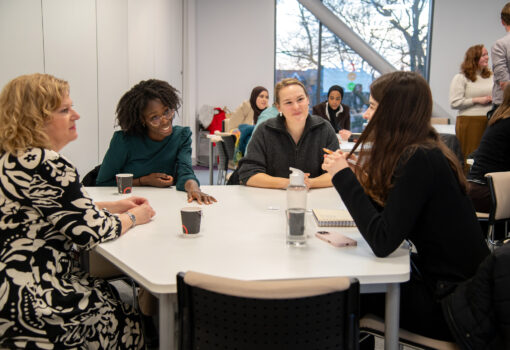
Browse our wide range of degree courses and find the perfect one for you.

Open days are the best way to find out what Lincoln Bishop has to offer.
Download your copy of our prospectus to find out more about life at Lincoln Bishop.