Search results
-
181.
Is Britain an example of state capitalism? New research argues it should be
A new publication written by James Silverwood, Bishop Grosseteste University and Craig Berry, Manchester Metropolitan University, explores British capitalism since the 19th Century and argues that is should be seen as the prototype project for state capitalism. -
182.
BGU Chancellor reflects on the life of The Queen in numerous media appearances
Following the announcement of the passing of HM Queen Elizabeth II, author and historian Dr Tracy Borman has provided commentary of the monarch’s life to national and international media. -
183.
BGU Senior Lecturer gifts copy of doctoral thesis at Wenlock Olympian Games
This summer, Senior Lecturer Dr Helen Bushell-Thornalley was a VIP guest at the Wenlock Olympian Games annual festival, where she gifted a copy of her doctoral thesis. -
184.
English at BGU celebrate top NSS rank
In the recent National Student Survey, BGU placed top in the UK for student satisfaction in Literature in English ranked top in the UK. -
185.
Sociology graduate and BGU student researcher speaking at TEDX event
The independently organised TEDx event aims to share bold ideas, long truths, and jaw-dropping creative visions. The day event will feature a speaker programme, discussion groups, workshops and is designed to help you dig deeper and turn ideas into actions. Robyn studied Sociology at BGU and was also student researcher on this two-year project to that provided a programme of activities to raise awareness, share learning and promote progress using Participatory Action Research, to make BGU better placed to promote inclusion. Earlier this year, Robyn also gave a poster presentation at the International Conference on Women’s Leadership and Empowerment in Amsterdam on the project ‘Enabling Gender Equality in Leadership: an exploration of leadership and self-awareness at Bishop Grosseteste University’. Robyn Jackaman said: “I’m delighted to be speaking at the TEDxBrayfordPool event this November. I’m incredibly passionate about social change, gender and identity. “I’m currently aiming to accomplish a PhD in Education and work towards legislative changes in the British sex education, and I’m always up for a chat about my areas of research.” Photo credit: www.tedxbrayfordpool.com/tedxybp -
186.
BGU Military History student completes work placement with GCHQ Departmental Historian and produces research article
The second-year work placement module is an important component of all the history degrees delivered at Bishop Grosseteste University. Students have the opportunity to experience a work-based placement or undertake a career-focused research project, where they gain hands-on experience and put their skills into practice. A Military History student undertook a work placement with the Government Communications Headquarters (GCHQ) Departmental historian as part of his degree. You can learn more about the skills and experience he gained from the work placement below. “For my work placement, my tutor found me a special project in my area of interest, signals intelligence, working with Dr David Abrutat, historian for GCHQ. The project focused on local history at a former RAF intercept station, Branston Mere in Lincolnshire, but it also included the wider role these Y stations played in the history of signals intelligence. The research drew on several sources, including individuals’ accounts and photographs held by the Branston history group, documents held in the National Archives, and by the RAF and International Bomber Command Centre Digital Archive, as well as the knowledge and research to date held by my tutor, Dr Claire Hubbard-Hall. Piecing together the evidence highlighted the significance of the site and the wider signals intelligence contribution both in detecting the emergence of re-armament in Germany after the First World War, and in supporting the code-breaking work carried out at Bletchley Park during the Second World War. The placement was a great opportunity for me to explore and collate new information that contributes to our understanding of the complexity, inter-dependencies, and importance of signals intelligence operations, from its inception at the start of the twentieth century through to the Cold War era” - BGU Military History Student Speaking about the experience Dr David Abrutat FRHistS FRGS, GCHQ Departmental Historian added: ‘Collaboration projects, like this one with BGU, are important to me and my Department. Our rich history is as broad as it is deep and many of the Second World War collection sites have little in the way of researched history. This piece by a BGU Military History student has brought one of the most significant RAF SIGINT sites in the country to life.’ You can read their published article below. Research Article If you are interested in studying Military History at Bishop Grosseteste University please click here. You can find out more about the range of history courses on offer at one of our forthcoming open days. You can follow the activities of the Military History team on Twitter @BGUMilitaryHist. -
187.
Autistic Perspectives to be Explored in Third Bishop Grosseteste University Participatory Autism Research Symposium.
Wednesday 16th November 2pm -
188.
Bishop Grosseteste University Third Participatory Autism Research Symposium Reflection
On 16th November 2022, Bishop Grosseteste University hosted it's third Participatory Autism Research Symposium. -
189.
Theatre beyond barriers
BGU graduate tours sensory shows for PMLD audiences -
190.
Over £420k invested in local archaeological research
Bishop Grosseteste University (BGU) has received a grant of more than £427,000 from the Arts and Humanities Research Council (AHRC) to invest in the university’s archaeology department. The award was confirmed in a ministerial announcement by Science and Technology Secretary Chloe Smith. The grant is awarded to institutions that seek to upgrade facilities and enhance their capacity to contribute to the UK’s creative and cultural research economy. BGU has used the grant to refurbish teaching rooms and the archaeology laboratory on campus. The university’s Old School House will now host the new open access Lincolnshire Culture Heritage Research (LCHR) Hub. The funding has also enabled the purchase of state-of-the-art equipment to enhance the research capabilities of the department, including a 3D laser scanner and a drone fitted with a LIDAR sensor, which can produce high-resolution maps and 3D models of landscapes and historical buildings. Other new equipment such as a magnetometer and a ground penetrating radar allow archaeologists to “see” into the ground and identify what lies beneath without having to excavate. The equipment will be used at the university's upcoming archaeology field school, which will see excavation of the Haw Hill area of Swanpool in Lincoln, where significant archaeological findings are expected. Dr Derwin Gregory, Archaeology Programme Leader at BGU said: "The AHRC grant has allowed us to significantly enhance our facilities and research capabilities, enabling us to provide our students with a first-class learning experience. “The equipment purchased through this funding will also benefit the wider community of archaeology and history groups, who are encouraged to contact the department and arrange use of this sophisticated equipment for their own projects." The AHRC is the UK's largest funder of research and postgraduate training in the arts and humanities. As part of UK Research and Innovation (UKRI), it provides funding and support to institutions in the UK. The funding programmes are designed to support research across the full range of arts and humanities subjects. UKRI is investing £103 million to expand and upgrade the UK’s world class research infrastructure, including digital infrastructure. The investments will support the sector and ensure UK researchers have access to the best labs and equipment they need to keep producing world-class science. UKRI International Champion, Professor Christopher Smith, said: “The investments, made across the UK, will provide UK researchers with advanced equipment, facilities and technology, and help maintain the UK’s position as a leader in research and innovation. “This support will ensure the UK is an attractive place for scientists, researchers and entrepreneurs to live, work and innovate.” A full catalogue of equipment available to use can be found here. Dr Derwin Gregory with the Trimble R12
Explore Lincoln Bishop
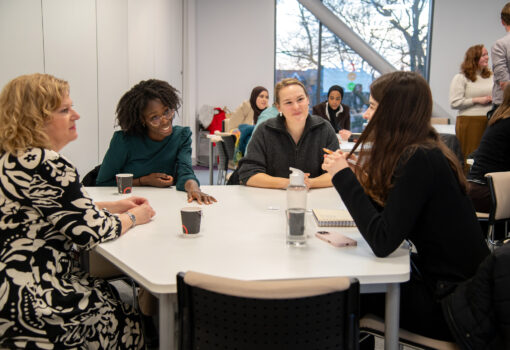
Browse our wide range of degree courses and find the perfect one for you.

Open days are the best way to find out what Lincoln Bishop has to offer.
Download your copy of our prospectus to find out more about life at Lincoln Bishop.