Search results
-
161.
Online software offers an ‘Evolution’ in learning for Entrepreneurship students
Although for some the COVID lockdown has created feelings of isolation and disconnect, it has provided the Team Entrepreneurship (TE) students at Lincoln Bishop University the opportunity to trial world-class simulation software that allows remotely and virtually 'run' an entire company. The software, called ‘Evolution’ allows participants to 'take over' a virtual company which has a trading history, product in development, staff and premises. As its new managers, they must use all of the information available to them in order to make decisions that affect staff, buildings, raw materials, sales and ultimately profitability, running the company over a number of virtual years. As in real life, all decisions impact on profitability and bad decision can have an adverse effect. Senior Lecturer Chris Jackson discusses how the software, created by a York based company called Simventure, became an invaluable tool on the course: "I had come across their product online while researching materials for both the TE course and the new MSc International Business and noticed that it's used globally by some big business schools. I wanted to know more, so I just picked up the phone and struck up a conversation with the company. It turns out that their CEO and I share similar backgrounds and are pretty passionate about entrepreneurship. The programme seems a perfect fit for the MSc, where we'll now be using it as the backbone of one module." "With the continuation of lockdown after Christmas, we realised that there was a possibility that Team Entrepreneurship students could struggle to create the learning experiences needed for them to be able to complete assignments - the Evolution programme seemed to be a perfect compromise, and we'll be introducing this to our learners in the next few weeks.". "We want to keep our students' learning as real as possible while encouraging them to try new strategies and tactics. Of course, things may go wrong, but then unlike real life, Evolution has 'pause' and 'rewind' features!" Alongside this, students are currently testing their business thinking and planning capabilities by using another online tool called Validate. Not only can this be accessed remotely, but it encourages learners to share their work with their peers and with supervisors. It doesn’t take students long to realise that the answers that they are looking for are neither in their heads of in text books - by gamifying their learning they are challenged to take their thinking outside of the classroom. Unlike many traditional models of venture creation, Validate also features sustainability in the initial stages and challenges the learner to map their thinking to the United Nations Sustainable Development Goals (SDG’s). Now also introduced as an integral part of future business courses, this is another way in which Lincoln Bishop can combine ethical and sustainable thinking in our programmes. If you'd be interested in experiencing a 'virtual' business experience for your students or staff, you can contact Chris Jackson at chris.jackson@lincolnbishop.ac.uk. To find out how you can create your own successes in our collaborative learning community, visit our website, speak to a member of our Enquiries Team or join us on one of our Open Days. Image credit (©Simventure) -
162.
BGU Lecturers suggest improved disaster risk reduction policy for Bangladesh
Bangladesh has more than 700km of coastline within the Bay of Bengal (BoB). It is a low-lying flood plain and high population density country. Due to the geographical location and topography, any cyclonic activities on BoB and beyond on it, on the Indian Ocean, impact on the coastal communities in Bangladesh. (Below photo: Approximate origin and path of severe tropical cyclone Amphan on May 2020) -
163.
Students and lecturers launch new documentary on their work to 'plot new worlds' as part of Being Human 2020
A group of Lincoln Bishop University (Lincoln Bishop) students and lecturers have launched a new documentary showcasing their contribution to the Being Human Festival amidst the pandemic.The documentary, directed and produced by third-year English Literature student Tyson Warren, reflects on an autumn 2020 poetry event held at Lincoln Bishop on the theme of 'plotting new worlds' which featured the 2020 John Pollard Foundation International Poetry Prize Winner, Isabel Galleymore.Ideas for the event and documentary sprung from a module in Lincoln Bishop's English department devised by Dr Jonathan Memel called 'Writing the Environment'. This final-year module aims to bring students' understanding of environmental literatures to bear on pressing questions in the environmental humanities today. -
164.
BGU to host BAAL Language Policy Forum 2021
Lincoln Bishop University is this year’s host of the British Association of Applied Linguistics (BAAL) Language Policy Forum 2021 which is taking place from 27-28 May. Key-note speakers Prof. Wendy Ayres-Bennett (University of Cambridge) and Prof. Joseph Lo Bianco (University of Melbourne) will be joining us, along with researchers from the UK and around the world, to discuss the latest issues in language policy in all its forms. Lincoln Bishop, the Communication & Language Research & Knowledge Exchange Unit and the TESOL team are delighted to have been chosen to host this year’s online event. Dr. Abigail Parrish, chair of the local organising committee, says: “It’s a real honour to be able to host such esteemed colleagues from such a wide range of countries and backgrounds at Lincoln Bishop. We’re so excited to hear about the latest research in all aspects of language policy.” For tickets and more information, click here. CoLa (Communication and Language RKEU) and the TESOL team at Lincoln Bishop have continued to develop innovative ways of teaching and adapting their research and national and international partnerships over the course of the pandemic; hosting the BAAL LP2021 is another example of this commitment. For more on in Linguistics and TESOL with Lincoln Bishop, see our course information here. -
165.
BGU Team Entrepreneurship Graduate Secures Role as an Associate Team Coach
Bishop Grosseteste University Business (Team Entrepreneurship) graduate Jordan Shaw has secured a role an Associate Team Coach at Birmingham's Aston Business School. Jordan, who graduated from the course in 2020, will be working with students on Astons' Team Entrepreneurship programmes where he will be growing the links and connections that he established while studying at BGU. Team Entrepreneurship Programme Lead Chris Jackson commented: "Jordan's progression is pretty unique in that while at BGU he was also awarded a bursary to study International Team Mastery with UK-based Akatemia CIC. This saw Jordan travelling to visit other institutions running Team Academy style courses including TAMK in Finland. "It's sometimes assumed that the TE-style courses are all about business start-up, which they're not. Some graduates do indeed and pursue self-employment but the most important outcome is that we develop graduates who are equipped to meet the challenges of the modern world. "As interest in team learning continues to grow globally, within organisations as well as HE, it's important that progressive institutions embrace this as a way to meet the demands of learners. It's great to see Jordan moving into such an exciting and rewarding career." You can find out more information on our Business courses by clicking here, speaking to a member of our Enquiries Team, or by joining us at one of our Open Events. -
166.
BGU Staff Members Contribute to Award Winning Book
Lincoln Bishop University’s Dr Andrew Jackson, Head of Research, and Dr Rose Roberto, Teaching Resources Librarian and History Lecturer, have contributed to The Edinburgh History of the British and Irish Press, a unique resource recently awarded The Robert and Vineta Colby Scholarly Book Prize by The Research Society for Victorian Periodicals (RSVP). The Edinburgh History of the British and Irish Press is a collection of essays examining nineteenth-century British and Irish newspaper and periodical history during a key period of change and development. It covers an important point of expansion in periodical and press history across the four nations of Great Britain (England, Ireland, Scotland and Wales), concentrating on cross-border and transnational comparisons and contrasts in nineteenth-century print communication. Designed to provide readers with a clear understanding of the current state of research in the field, in addition to an extensive introduction, it includes forty newly commissioned chapters and case studies exploring a full range of press activity and press genres. Practical features in this tome, which probably swayed the panel, include a helpful timeline of significant events in the history of printing technology intersecting with social, political, and cultural history. There are also a large selection of high-resolution images showing 19th-century visual and tactile material that readers will find engaging. The Colby Prize is for original book-length scholarship about Victorian periodicals and newspapers and in awarding it to The Edinburgh History of the British and Irish Press, the RSVP praised the new book for being “a remarkable, wide-ranging resource that gives welcome attention to diversity and transnational connections.” Continuing their praise the society added: “It will be valuable for a wide range of readers. RSVP is pleased to honour the work of all the writers as well as the editor, who together have made a contribution to nineteenth-century periodical studies that will remain a standard for many years to come.” Dr Roberto and Dr Jackson authored chapters 3 and 26 respectively. Speaking after the announcement Dr Jackson discussed what readers could expect from the book: "Our newspaper media today owes much to its history of rapid expansion and cultural diversification during the nineteenth century. This volume provides a definitive survey, and a wide-ranging and deep exploration. It was privilege to contribute, offering perspectives on the great outpouring of local and regional newspapers, and what these tell us about the development and character of the communities and districts in which we live today." Dr Roberto shared her excitement at her inclusion and on the potential impact the book could have: “I was delighted to find out that my paper at an international conference in Edinburgh, called “Communities of Communication” was the basis of an award-winning book. There were numerous outstanding presentations that were delivered over two days, and I am pleased and humbled that my research on Victorian-era illustration was chosen by editor David Finkelstein for inclusion in this comprehensive volume.” The Edinburgh History of the British and Irish Press is available as an e-book at the Lincoln Bishop Library. Members of the Lincoln Bishop community can access it by clicking here. To create your own successes in our collaborative learning community, visit our website, speak to a member of our Enquiries Team or join us on one of our Open Days. -
167.
Crafting the future unwritten: Winners announced in short story competition
‘Water is Thicker than Blood’ by Sophie Harrison as been awarded first place in the Lincoln Bishop University English Department 'The Future Unwritten' short story competition. Designed to bring together GCSE and A-level students with a passion for creative writing, and inspired by one of our undergraduate modules, the competition tasked entrants with crafting a short story that speculated about the future. Submissions included imagining of new realities and new identities, adaptions and transformations of our current world and covered a wide range of genres including dystopian fiction, science fiction, fantasy and horror. Speaking as they choose the winners, the judging panel, made up of lecturers from Lincoln Bishop's Department of English, recognized by The Sunday Times and The Guardian as among the top thirty in the UK, praised the high quality and diverse variety of entrants: "Thank you to the many who were able to enter their short stories. We were delighted to receive such an engaging range of submissions for the inaugural short story competition and it is very encouraging to witness the creative passion of these young people. We look forward to building on this success to promote the talent of young writers, starting with a new competition in 2022." -
168.
Holocaust survivor and discrimination campaigner among those recognised with honorary awards at BGU in 2020 Graduation Ceremonies
Lincoln Bishop University is delighted to recognise an incredible group of individuals with honorary doctorates as part of its 2020 graduation ceremonies. Those selected represent a wide range of backgrounds including Holocaust survivor and discrimination campaigner Simon Winston, Operations Manager for the England Men's World Cup winning Cricket team in 2019 Phil Neale and the former Director of INSET at the National Centre for Language and Literacy Prue Goodwin. You can read more about each of the exceptional recipients below: -
169.
Autism Ideas Café Update July 2021
The July session of the Autism Ideas café welcomed attendees from the UK and beyond and was based around three discussion topics. International Perspectives on Autism and Autism Research – The discussion was informed by a description of the situation regrading diagnosis, support and public attitudes towards autism in Hong Kong led by an autism researcher living in Hong Kong. She explained that in Chinese, the word for autism means to “self-isolate or self-enclose”, and that much of the focus of support for autistic children tends to be around encouraging them to present as being “less autistic”, and advised that there is very little focus on adults with autism. Autistic children may be referred to as “children of the stars”, which can perpetuate the view that autism is something which is only experienced by children. The discussion was further supplemented by a group member from New Zealand who shared their experiences of receiving a diagnosis of autism as an adult. Employability Support for Neurodivergent Women – an innovative approach Darkside Rising , a community interest company based in Lincolnshire gave a presentation on their innovative programme of support for neurodivergent women which includes weights-based strength training and mindfulness. More information on their programme can be found here. Diagnosis or Self-Identification – Implications for Research The discussion focussed on the issue of formal diagnosis and self-identification of autism, and how these differ in relation to their implication on autism research. General consensus of the group was that for general autism research, self-identification is perfectly valid, but that depending on the research question being explored, then specifying diagnosis as an inclusion criterion is acceptable, particularly where research focusses on experiences relating to the diagnostic process. Save the Date – the next Bishop Grosseteste Participatory Autism Research Symposium has been scheduled for the 13th October, with further details of the agenda to be shared nearer to the date. Register Here. The next Autism Ideas Café event will be held online on Wednesday 8th September. Register Here. -
170.
Remembering 9/11 Twenty Years On
On the morning of September 11, 2001, an American Airlines Boeing 767 crashed into the north tower of the World Trade Center in New York City. Worldwide, millions watched in shock as events were broadcast by live television coverage. Many remember the chilling footage of the second plane hitting the south tower and the later collapse of the twin towers. At 9.45 am (Eastern Standard Time - EST), a third plane hit the Pentagon in Washington D.C. At 10.10 am (EST), a fourth hijacked plane crashed in a field in western Pennsylvania. United Flight 93 had been delayed leaving Newark Liberty International Airport, leaving time for some of its passengers to learn of the attacks in New York and Washington from cell phone calls. A group of brave passengers and flight crew fought the highjackers preventing the terrorists from weaponising the plane and taking out their fourth intended target, either the White House or the U.S. Capitol. The coordinated attacks were carried out by the Islamic extremist group al Qaeda. Nearly 3,000 people lost their lives that day. Twenty years on, historians at Bishop Grosseteste University share their memories of a day that changed the world. Dr Claire Hubbard-Hall, Programme Leader for Military History. I was weeks away from submitting my Master's' dissertation when 9/11 happened. The day the planes hit the World Trade Center, I had broken away from editing a dissertation chapter. I made a sandwich and then switched on the weighty analogue box television that occupied the living room corner. Images of destruction and devastation greeted me. News of the attacks in New York dominated both BBC and ITV channels (two of just five channels then). For the rest of the day, I sat transfixed, unable to make sense of the news that followed. In an era before social media, the live broadcast made it feel as if I were there. I watched in horror as the Twin Towers plummeted to the ground. At the time, I felt sick. Looking back, I still do. During my doctorate, I spent some time in New York as a Fritz Halbers Fellow researching aspects of the Holocaust at the Leo Baeck Institute. In 2006, on a bitterly cold January morning, I visited the site of the 9/11 attack. Standing silently in Lower Manhattan, I felt overwhelmed with emotion, still unable to process the unthinkable. As we mark the 20th anniversary of one of the deadliest terrorist attacks in history, I wonder how much 9/11 is shifting from lived experience to a historical event connected to the years of history before and after the 9/11 attacks. Dr Hazel Kent, Lecturer in History. I was rushing from my classroom to the staffroom to grab a much-needed cuppa after a busy lesson (some things don't change). A colleague stopped me in the corridor: "Have you heard what's happening in New York?" I hadn't. There wasn't easy internet access in a Lincolnshire comprehensive at that time, and certainly not in my History classroom. I went over to the Science block, to the technician's long, thin preparation room; this was the only place in the school with a live television signal. Surrounded by the chemical bottles and equipment, I remember watching the coverage in disbelief and trying to make sense of what was happening as more and more staff crowded into the tiny space to do the same. I remember the confusion as TV reporters tried to explain, as the horrific trauma of a carefully coordinated terror attack began to unfold thousands of miles away. Watching the coverage of the event certainly had a profound effect on me. From a historian's point of view, it is interesting to reflect on the experience of watching such a significant event unfold in real-time before its narrative has been created. Dr Alan Malpass, Lecturer in Military History. I've lived my entire adult life in the post-9/11 world, but my memories of that day are hazy. I do remember, quite vividly, sitting on the sofa in my parents living room watching news reports of the attack. I had just returned from school, so it must have been around 4 pm (BST). My dad was still at work, but my mum was watching the TV. I remember walking in and seeing her stood in the middle of the room. I immediately felt that something serious had happened, and I sat down. I don't remember us speaking a lot, but just sitting and trying to comprehend the news coverage. I didn't understand what had happened – I don't think anyone did at that point. I'd never heard of the 'Twin Towers' or thought much about terrorism, but the chaotic images made an instant impression. The sense that something tragically earth-shattering had happened was clear. Twenty years later, I now find myself teaching the events of 9/11 and terrorism on some of the modules I deliver. They are requisite to understanding the world we live in today. Further information about the 9/11 Memorials can be found at The 9/11 Memorial & Museum, Flight 93 National Memorial and The National 9/11 Pentagon Memorial.
Explore Lincoln Bishop
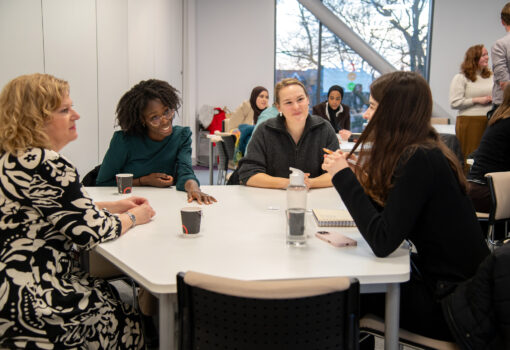
Browse our wide range of degree courses and find the perfect one for you.

Open days are the best way to find out what Lincoln Bishop has to offer.
Download your copy of our prospectus to find out more about life at Lincoln Bishop.