Search results
-
101.
BGU Community Supporting Coronavirus PPE Efforts
Members of the Bishop Grosseteste University (BGU) community have been working hard to support the County’s drive to get vital PPE to essential front line workers. Luke Pennington, Analyst Programmer at BGU, has been using the University’s 3D printer to create headbands to produce face shields for Health care workers. Although he wasn’t always the biggest fan of the process he was keen to support others when the opportunity arose: “I’m not really a fan of home 3D printing under normal circumstances as I think it raises a number of questions around the environment and the spread of plastics. However, I read in the press about home enthusiasts printing PPE kit for healthcare workers and realised the University’s 3D printer could be an excellent tool for supporting this. As an individual printer I wouldn’t be able to produce enough shields fast enough on my own my but I found a Lincoln group of volunteers coordinating supply and demand and got approval to join in. I have been printing for about 5 weeks now and have produced over 80 shields. The completed shields are sent onto the group which distributes them so I’m not involved directly in sending them out but my first batch went towards the East Midlands Ambulance Service, Lincoln County hospital, local care homes and A & E departments.” Lynne, from Flower Park Care Home, was one of the health care professionals to receive a face shield made by the volunteers and she was full of praise for the impact of their efforts: “It’s fantastic that the group have made these face shields and all of us at Flower Park care home are really grateful as we feel so much safer at work wearing them.” In addition BGU was approached by 3DCrowdUK which is a Non-Profit Voluntary Organisation set up to help provide PPE to NHS and Key Workers during this pandemic. The University’s Hardy Building has now been transformed into a logistics hub for Lincolnshire, collecting and redistributing PPE being manufactured to volunteers all over the county. Alongside BGU’s offer of facilities a number of its furloughed staff, particularly from the Estates team, are volunteering in various capacities from Hub Coordinator to logistics coordinators and drivers. -
102.
A Message of Thanks to the BGU Community
Bishop Grosseteste University is aware of the ongoing press coverage regarding university students within the UK and is constantly monitoring the situation for our students. A small number of staff and students have reported symptoms and the University has ensured that each person has observed the required period of isolation in addition to arranging for a COVID-19 test. So far, we have not had any students or staff attending campus with a positive test result. We would like to thank our community of staff, students, and their families for their combined efforts to limit the spread of the virus, especially now that teaching has resumed. The Students’ Union has been pivotal in liaising with the student body to ensure that we collect and act upon feedback, and this will continue throughout this year. The University has put in place extensive measures to limit the spread of COVID-19, including enhanced cleaning regimes, increased handwashing and sanitising facilities, the wearing of face coverings and extensive signage to promote safe space and social distancing. We have provided clear guidance (see Working Together) on how we can all help each other to stay safe, socialising in groups of up to six and how to tell us if you need to self-isolate and / or get a test. Once you tell us then we will provide advice and support on learning and teaching, living in accommodation and well-being whilst you are self-isolating. We provide 24/7 mental health support to all students, and we encourage everyone who needs to, to use that facility and seek the support of staff including- Student Advice, Chaplaincy, the Students’ Union and tutors. BGU is proud of our community and we are aware that the current limited impact of the virus on campus is down to the responsible behaviour of everybody. Thank you for your help and support. The Reverend Canon Professor Peter Neil - Vice-Chancellor Erin Bell - President: Union Development -
103.
English Department provides ‘A Night in With Shakespeare’ for BGU students
The ongoing period of COVID-19 has created a number of challenges to the Higher Education experience of students and staff across the country. At Bishop Grosseteste University (BGU) the English Department Team have risen to the task of finding innovative and adaptive ways for students to interact and learn socially as Dr Amy Albudri, Lecturer in English at BGU, explains: -
104.
Autism Ideas Café Update January 2021
The first Autism Ideas Café event of 2021 welcomed new faces and led to some lively on-line discussions. Each event held so far has been unique, with a different mix of attendees made up of academics, professionals, students, members of the autistic community and their allies. What makes each event special is the views, knowledge and experience that each attendee brings, as well as the diversity of topics of discussion. The January session included musings on the need for researchers to communicate their research findings so that they are relevant, easily accessible, and relatable to real life situations, as well as discussions around a number of autism related issues. Employment: How can employers be more inclusive? How can their awareness of autism be raised? The importance of making workplace adjustments. Understanding what employers can gain from having a neuro-diverse workforce. How can research be used to support the increased employment of autistic individuals? Diagnosis: How can adults on the spectrum get a diagnosis? Should they pursue one? What difference does it make? Do the diagnosis rates in boys and girls actually reflect the incidence of autism? Are girls on the spectrum treated differently? Do they get diagnosed with other issues instead? The experience of girls and women on the spectrum: How do autistic women cope with the hormonal and physical changes of puberty and menopause? Are girls more likely to mask their autism? Does this manifest in mental health issues such as depression or eating disorders? Are girls as likely as boys to have a “special” interest? Are these seen as hobbies? Autism and parenting: Being an autistic parent. How does late diagnosis of parents affect children? If a parent gets an adult diagnosis does that affect the child? Do autistic parents parent differently? How can parents empower their autistic children? How can parents meet the sensory needs of their children? Many of these themes will be explored in the March Autism Ideas Cafe event, which will be in the format of a research symposium, including presentations of their current research by PhD and Master's students from BGU. Details TBC. -
105.
Perceptions of Death in Collective Memory: Numbers | Spaces | Texts (2021-22)
Research by Sibylle Erle Death is an abstract concept. I have always been interested in Death; not because I am morbid but because I want to live a better life. Having co-organized Academic and Creative Responses to Death and Dying (since 2017) with Peter Green at BGU, I realised that I needed to move on as well as back into my own discipline. I wanted to contemporize my interest in Death, which is rooted in the Romantic period where it connects to my research on Mary Wollstonecraft, Joanna Baillie and Mary Shelley. This is how it happened. In conversation with Dr Makrina Agaoglou, from the Institute of Mathematical Sciences (ICMAT) in Madrid, I realised how Mathematics could inform and teach non-mathematicians about how mathematical modelling can give some inside information on what is happening and if and how outcomes can be predicted. Sophie Ungerer a London-based architect and designer working at the University of Brighton, on the other hand, showed me how COVID-19 has affected the way we move in our minds and through our cities, including the spaces designated for preoccupation with death, such as graveyards, (makeshift) morgues or memorials. In my head I quickly moved from “What is the maths behind the current pandemic?” to “How should we inhabit public spaces – as well as the intimate space between us”. Our project seeks to explore the perceptions of death in the context of COVID-19 and how they were affected by the pandemic. COVID-19 has been represented by mathematical graphs describing a global phenomenum, that are abstract and not always easily processed by the public; the data, moreover, is counterpointed by a plethora of individual stories about loss, mental health and lockdowns. Yet, though the threat of death is omni-present and has shaped our societies and lives irreversibly, many still have not experienced death first-hand. Death is well-documented in the public eye, but all too often the dying had to die alone to ensure the safety of their loved ones and related communities. This disconnect - between the public and the private - has to do with how we process ‘the facts‘. Through our project we want to take stock of how the current situation is poised; it is not about knowing or not knowing, it is rather to do with accepting or rejecting ‘the facts‘. Using interdisciplinary collaboration, we aim to explore the perceptions of death: from the abstract, for the general public, the parameters that affect the spreading of the virus and thus define social distancing, to how empirical experience of death may be represented in text and space. Our project is funded by AlumNode (a collaboration between the Heidelberg Laureate Forum Foundation (HLFF) and the German Scholars Organization (GSO), funded by the Klaus Tschira Stiftung (KTS). Facts rarely produce empathy; and this is where the TEXT (Literature) comes in. For any information contact Sibylle Erle, FRSA, FHEA, who is Reader in English Literature and lead of RKEU Literature and Literacies. She teaches on the English programmes as well as on MA Children’s Literature and Literacies. Our first event on 2 November brings together Speakers from different disciplines who will explore ‘Death’ from different angles: we will have short presentations, a round table and a creative workshop; This will be lead by artist Marina White Raven, who I have been working with since the first Lockdown on a story titled, 'What did you do during lockdown?' - Find out more about that story here. What remains? Each point or number on those graphs holds its own story. Is it personal stories that will compete with the trends in the formation of the collective memory of the time we are now living through? How do we perceive, construct as well as represent Death in our daily lives? For details: https://www.icmat.es/congresos/2021/PDM-NST/index.php To register: https://predictiondeathmemory.eventbrite.co.uk -
106.
Perceptions of Death in Collective Memory: Numbers | Spaces | Texts
Perceptions of Death in Collective Memory: Numbers | Spaces | Texts Project & Collaboration Dr Sibylle Erle, FRSA, FHEA (Reader in English Literature), Bishop Grosseteste University, Lincoln Dr Makrina Agaoglou (Postdoctoral Researcher), Spanish National Research Council (CSIC), Institute of Mathematical Sciences (ICMAT), Madrid Sophie Ungerer, FHEA, ARB (Senior Lecturer & Architect), University of Brighton Phase 1: Completed. We have submitted a proposal to present our work at Academic and Creative Responses to Death and Dying, organised by the Chaplaincy at BGU. Phase 2: Collaboration This collaborative project has been an inspiring journey into new territory for all three if us, bringing together a mathematician, an architect and myself, a Reader in English Literature. I am still scared of numbers, but I am getting better at reading graphs and listening to my colleagues. This collaboration has brought us together. We started breaking down complex ideas for each other and in return learned to look at our disciplines from a new angle. We are not afraid to push back and insist on what we feel passionate above. We are now playing to our strengths, and we are having fun! Why collaborate? I work on William Blake and my chosen field of research is well established. I enjoy trying to break new ground and make new connections between ideas and different fields of research. I am good at making connections between ideas that might seem unexpected but often flourish. I am also good at underestimating myself. When things go wrong, sometimes it is difficult to draw a line (let go) and move on. To make it work there needs to be openness and respect between colleagues, trust in cooperation, determination, focus, persistence, and excellence. As we are moving into the second phase of our project, I am excited to explore where our collaboration will take us as a team and me personally. At BGU Blake and Death are taught as part of the Romanticism, Young Adult and Children’s Literature modules (Undergraduate English Programmes – joined and single honours) and the MA Children’s Literature and Literacies strand of the MA English Literature. -
107.
BGU awarded silver Hedgehog Friendly Campus
The university improves on their previous bronze accreditation after implementing a number of hog-friendly measures across campus. -
108.
Bishop Grosseteste University’s results in Research Excellence Framework 2021
BGU is committed to supporting excellent research in all its forms. Research and knowledge exchange at the University also achieves impact in its local and regional communities, as well as nationally and internationally, it underpins its doctoral programme provision, and engages students in research-informed learning and teaching. BGU’s submission to REF 2021 reflects a period of significant growth in its research and knowledge exchange. Two more Units of Assessment have been added to the three that were returned in REF 2014, there has been a four-fold increase in the number of staff submitted, a near three-fold increase in the number of outputs, and a four-fold increase in research income. The University submitted work reflecting established fields of research expertise in Education, English Language and Literature, and History, and made its first entries in Psychology, Psychiatry and Neuroscience and in Theology and Religious Studies. The results include published outputs of world-leading quality and acknowledge fields of internationally excellent public impact, and a rich, vibrant, and diverse research environment and culture. Vice-Chancellor, Revd Canon Professor Peter Neil, said: “These results mark an important milestone in BGU’s development as a provider with a reputation for excellence in research and knowledge exchange. “We have embraced the spirit of inclusivity in the REF and reflected research activity and interests across the whole of the institution. This successful outcome emphasises the breadth of our research, includes outputs which are regarded as internationally excellent and highlights our public impact with local, regional and international reach. “I am extremely grateful to colleagues for all their hard work in expanding and enhancing research at BGU over the last seven years. I would also like to take this opportunity to acknowledge the contributions of our external partners in supporting many areas of our research.” -
109.
BGU graduate sets up a social enterprise
Denise has over 40 years’ experience of teaching music and is a BA (Hons) Health and Social Care graduate from BGU. Denise explains “I have been employed for many years in the health and social care sector, working with young people in rehab, supported living and care home residential settings, young people and adults with learning difficulties and those suffering with mental health problems. I am passionate about helping them achieve their goals. I had thought about studying for a degree for years and after a change in personal circumstances decided that it was the right time to embark on the journey. I chose to study at BGU as the location is ideal and the group size relatively small. Any feelings of apprehension about going to university and worrying about being too old or not being able to cope with the work were soon dismissed. I had excellent teaching staff, was made welcome and put at ease. The student group consisted of a variety of ages, and I never once felt out of place. It was a friendly and supportive group. Admittedly at times it was difficult fitting everything in, work, an elderly parent to care for and the ongoing demands of family life; a husband, grown up children and grandchildren! I was determined to get through the whole experience and so pleased I did. I would not have missed it for the world. "Throughout the years I have used music, art and craft to improve wellbeing, build confidence and self-esteem, enabling people to perform and entertain. I believe that the arts can have a lasting and powerful effect on an individual's health. They can be a fun way to socialise and make friends.” Denise said “the support I received from Sarah at BG Futures has been extremely valuable and important. It has helped and encouraged me to continue and develop the confidence needed to run my own business. OUR ECLECTIC ARTS is available for anyone aged over 18 years and caters for all abilities. The service is bought to clients whether in their own home, residential or community setting. At present I am concentrating on a 30-mile radius covering Lincoln to Louth as well as coastal areas. "Regardless of age, if anyone is thinking of starting their own business my advice is to ask for help and advice and to talk through your ideas with friends and family. Do your market research to offer something different and go for it. To encourage others, I always say, if I can do it, so can you.” Sarah adds “Denise’s market research revealed that there are a limited number of organisations delivering wide-ranging art activities, in the community, to individuals that have difficulties accessing services. OUR ECLECTIC ARTS is dedicated to offering a broader range of activities within the Arts. Denise has a client centric approach and a genuine interest in improving people’s lives. This has been reinforced by choosing to operate as a social enterprise whereby trading profits will be reinvested to do more of this good work.” For more information about OUR ECLECTIC ARTS contact Denise on dpopple8@gmail.com Instagram: oureclecticarts Facebook: Our Eclectic Arts If you are a BGU student or recent graduate and are interested in finding out what support is available from the BG Futures team click here. -
110.
Bishop Grosseteste University celebrates excellent National Student Survey results
For three subjects in particular BGU placed in the top ten in the UK, with Literature and English finishing in first place with a satisfaction score of 100%, Sport Science ranking second with 96%, and Health Studies rising to 10th nationally with a 90% satisfaction score. The NSS is an annual survey for undergraduate students that invites them to share feedback on their university experience. Around half a million students are asked to give their opinions relating to various aspects of their course, including teaching quality, assessment and feedback, and learning community. The results help prospective students make informed choices about their education and provide important data for universities and colleges to improve their student experience. The latest survey results show BGU has made substantial improvements in ranking across all NSS core question categories. In the 2022 survey, BGU is ranked in the top 30 for eight out of nine categories – including first for timely feedback, third for student assessment and feedback, and sixth for learning resources. Satisfaction with access to learning resources has also improved, with satisfaction with library resources climbing to 4th, and access to course specific resources rising to 14th. Other highlights also include Education and Teaching Training course areas, placed in the top 25 which is their highest ever ranking to date, and Childhood and Youth Studies reporting above sector satisfaction rates. Rob Boast, Pro-Vice Chancellor (Students) at BGU, said: “The community at BGU prides itself on ensuring that students are a name not a number, and we’re pleased that so many of our final year undergraduates, who experienced all the turbulence of learning throughout the pandemic, have shared such positive feedback about their time with us. “As a small university we are perfectly positioned to offer our students a personal and tailored experience, so it is encouraging that areas such as academic support, assessment and feedback, learning community and student voice have reported high satisfaction rates. “The sharp rise in our ranking across several categories reflects a lot of hard work from our staff across all departments, working collaboratively to provide a student-focussed learning experience, and we will continue with our ambitious plans to expand on our outstanding record for student progression, achievement and employability on a national level.”
Explore Lincoln Bishop
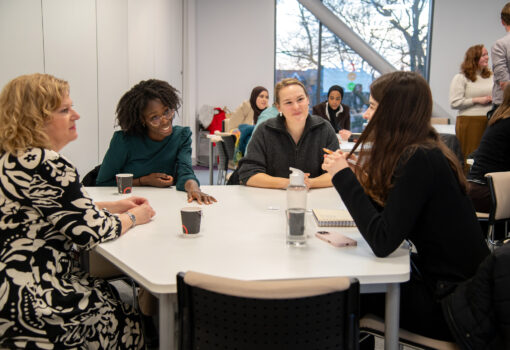
Browse our wide range of degree courses and find the perfect one for you.

Open days are the best way to find out what Lincoln Bishop has to offer.
Download your copy of our prospectus to find out more about life at Lincoln Bishop.