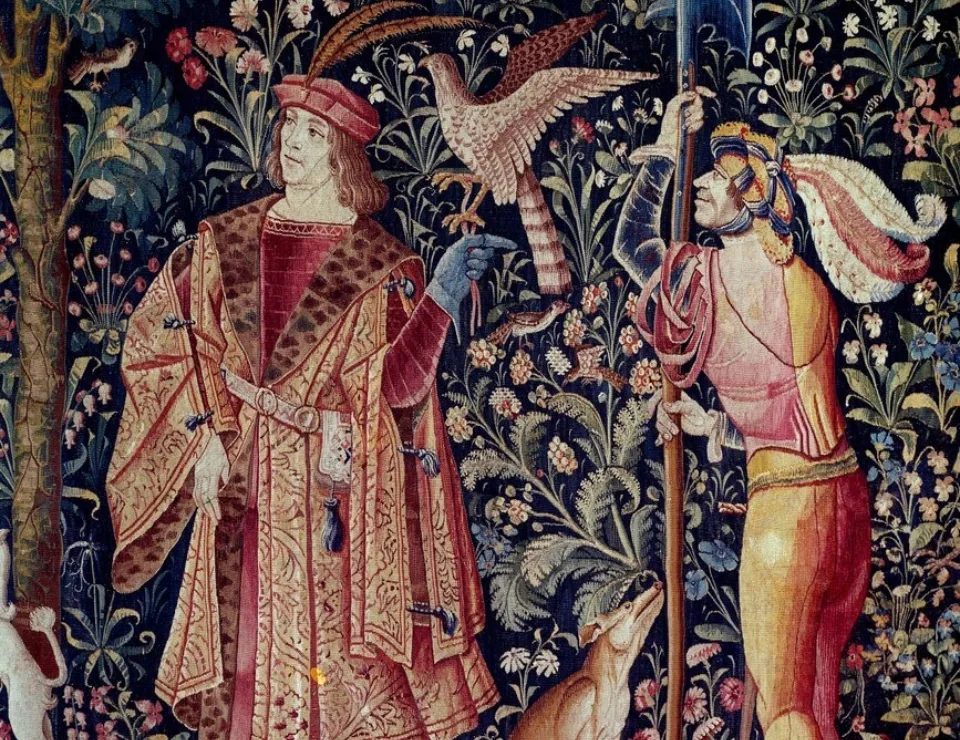
We were delighted to welcome one of our largest cohorts of new doctoral students to our first doctoral weekend in October 2025. As part of voicing their position at the very beginning of what will be a challenging journey, we invited some to share their ideas of how the above image might reflect where they are at this point, and specifically what their thoughts might be about how it could reflect the relationship between themselves and their supervisors.
This relationship is an important one to explore and develop. As suggested by Johansson et al. (2014), although ‘during a four- or sometimes five-year process it is probably impossible to avoid conflicts and emotional turbulence’, these conflicts frequently lead to valuable outcomes (p. 612). Seeing the same thing in different ways is part of what we do at doctoral level, and the subject under investigation is deemed to be less important than the questions that the investigation provokes (Brew, 2001).
The invitation to take part in this short, fun task was deliberately vague. One of the most important lessons at the start of a doctorate is to accept ‘messiness’, that there are seldom single answers to any issue, and that the ability to question, question, question is one of the first skills that needs to develop.
Our intentions in choosing this image – clearly, not the only interpretation in this context – was to convey that the hawk (who we perceived to represent the PhD candidate) is in partnership with the hunter (the supervisor) in a way that the servant and the dog are not. The relationship is one of mutual trust built on respect: ‘The hunter does not teach the hawk to fly and nor can the hunter fly himself, but he does support and guide the hawk to have the best chance of success’ (Lawrence and Collyer, 2022 p.27).
Not surprisingly, this relationship was not perceived in the same way by all. One doctoral student felt that they identified with the dog, ‘sit[ting] obediently between the lavishly adorned hunters in their fine feathers’. The candidate is ‘trapped between… danger and desire’ with the ‘prized, out-of-reach bird’ seeming very far away and – at least as yet – unobtainable: ‘There are a million moments when I believe I will never reach the bird’.
Another candidate suggested that the use of a tapestry might suggest the ‘mutual obligations of the feudal system’, itself representing a ‘reciprocity in the supervisor-supervisee relationship’. There was recognition of the ‘richness of the tapestry’, capturing something of the ‘the intricacy, the detail, the time invested [and] the skill of the creators’, and speculation as to whether this could allude to ‘commitment to a richness in collaboration and work’. Tapestry as a medium is ‘not of modern times’, just as the doctorate, with its long history and its traditions of oral defence of a thesis, is itself something that ‘may be seen as archaic and formal’. The subject itself – that of hunting – may evoke ‘singlemindedness, difficulty, perhaps privilege’.
Another perception was that the central figure looks out of the image to a space that cannot be seen by the servant, the dog or – in fact – the person viewing the tapestry. The conjecture was that this might imply a relationship where the servant/supervisor must only see the research through the eyes of the hunter/candidate. A further interpretation was that the image lacked perspective and was ‘something two-dimensional’, perhaps representing the ‘limits of the form’ and that ultimately the research in a doctorate has to be represented in the thesis by ‘2D words on the page’.
Ultimately, the different speculations were really the point. As Brew (2001) suggests, the subject under investigation may be less important than the questions that the investigation provokes. This short task built on an earlier piece of research undertaken with a doctoral student starting his PhD during the Covid 19 lockdowns (Collyer and Lawrence, 2022). Working together to discuss and share images and artifacts allowed us to explore ideas and to move forward during what was an otherwise very restricted time. The exercise was a fruitful one for us both, enabling us to explore ‘fundamental apprehensions of what research should be about, that are subtle and emotionally charged’ (Johansson, Wisker, Claesson et al., 2014 p. 613).
The doctoral supervisor/supervisee relationship is an important one for both parties. For each, the research represents a considerable investment of time and a commitment to engage. Between them (although, clearly, the primary responsibility lies with the candidate) they share a project, resulting in an output that is both a written thesis and – importantly –a defence of what has gone into it and been left out of it at viva.
Collyer and Lawrence, 2022 p.30.
Ultimately, one of the most important themes to emerge from that work was the importance of trust – both of the supervisors of the supervisee and the supervisee of the supervisors. As one of our current candidates on the doctoral weekend expressed, ‘I trust that the hunters will lead me well and that one day I will have my own bird’.
References
Brew, A. (2001). Conceptions of research: A phenomenographic study. Studies in higher education, 26(3), 271-285.
Collyer, E., & Lawrence, C. (2022). Taking time to appreciate the scenery: an exploration of PhD supervision as pedagogy. Hillary Place Papers, (7), 21-32.
Johansson, T., Wisker, G., Claesson, S., Strandler, O., & Saalman, E. (2014). PhD. Supervision as an Emotional Process-Critical Situations and Emotional Boundary Work. Pertanika Journal of Social Sciences & Humanities, 22(2).